


Close Menu
Meteorological Technology International
  • News
    • A-E
      • Agriculture
      • Automated Weather Stations
      • Aviation
      • Climate Measurement
      • Data
      • Developing Countries
      • Digital Applications
      • Early Warning Systems
      • Extreme Weather
    • G-P
      • Hydrology
      • Lidar
      • Lightning Detection
      • New Appointments
      • Nowcasting
      • Numerical Weather Prediction
      • Polar Weather
    • R-S
      • Radar
      • Rainfall
      • Remote Sensing
      • Renewable Energy
      • Satellites
      • Solar
      • Space Weather
      • Supercomputers
    • T-Z
      • Training
      • Transport
      • Weather Instruments
      • Wind
      • World Meteorological Organization
      • Meteorological Technology World Expo
  • Features
  • Online Magazines
    • January 2026
    • April 2025
    • January 2025
    • September 2024
    • April 2024
    • Archive Issues
    • Subscribe Free!
  • Opinion
  • Videos
  • Supplier Spotlight
  • Expo
LinkedIn X (Twitter) Facebook
  • Sign-up for Free Weekly E-Newsletter
  • Meet the Editors
  • Contact Us
  • Media Pack
LinkedIn Facebook
Subscribe
Meteorological Technology International
  • News
      • Agriculture
      • Automated Weather Stations
      • Aviation
      • Climate Measurement
      • Data
      • Developing Countries
      • Digital Applications
      • Early Warning Systems
      • Extreme Weather
      • Hydrology
      • Lidar
      • Lightning Detection
      • New Appointments
      • Nowcasting
      • Numerical Weather Prediction
      • Polar Weather
      • Radar
      • Rainfall
      • Remote Sensing
      • Renewable Energy
      • Satellites
      • Solar
      • Space Weather
      • Supercomputers
      • Training
      • Transport
      • Weather Instruments
      • Wind
      • World Meteorological Organization
      • Meteorological Technology World Expo
  • Features
  • Online Magazines
    1. January 2026
    2. September 2025
    3. April 2025
    4. January 2025
    5. September 2024
    6. April 2024
    7. January 2024
    8. September 2023
    9. April 2023
    10. Archive Issues
    11. Subscribe Free!
    Featured
    November 27, 2025

    In this Issue – January 2026

    By Hazel KingNovember 27, 2025
    Recent

    In this Issue – January 2026

    November 27, 2025

    In this Issue – September 2025

    August 11, 2025

    In this Issue – April 2025

    April 15, 2025
  • Opinion
  • Videos
  • Supplier Spotlight
  • Expo
Facebook LinkedIn
Subscribe
Meteorological Technology International
Polar Weather

Marine aerosols identified as cause of low-level summer ice-cloud formation over the Southern Ocean

Dan SymondsBy Dan SymondsDecember 14, 20213 Mins Read
Share LinkedIn Facebook Twitter Email
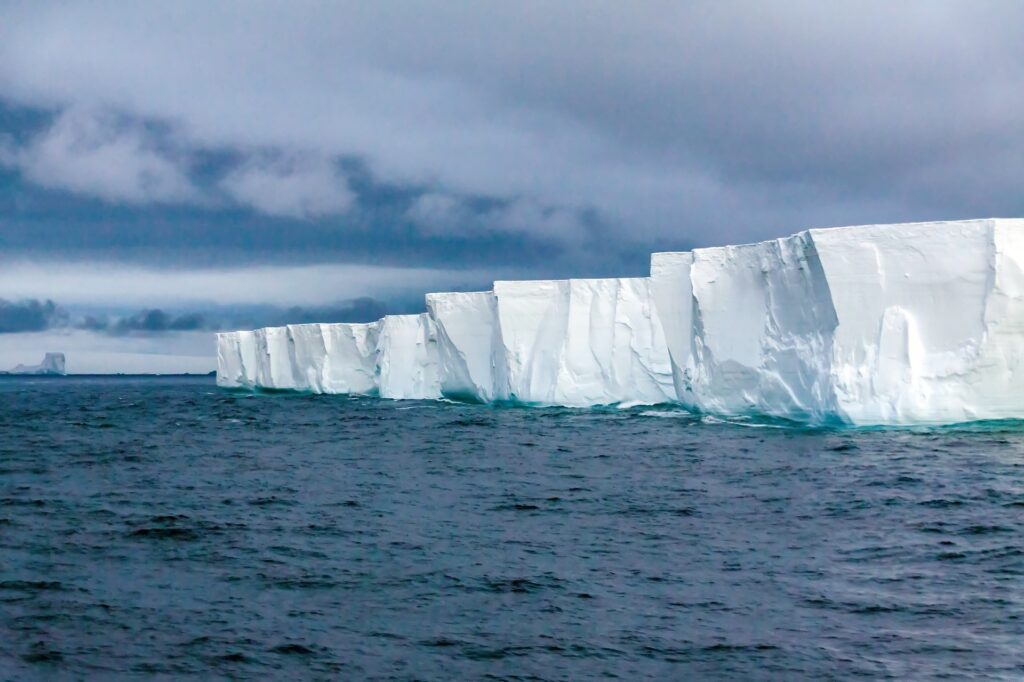
Antarctica - credit: Pixabay
Share
LinkedIn Facebook Twitter Email

Climate scientists from Japan have uncovered how marine aerosols contribute to ice cloud formation over the Southern Ocean during the summer months, when temperatures are comparatively high.

Kazutoshi Sato, assistant professor from Kitami Institute of Technology, and Jun Inoue, associate professor from the National Institute of Polar Research, used data captured by the NASA/CNES joint-venture Cloud-Aerosol Lidar and Infrared Pathfinder Satellite Observation (CALIPSO) satellite to estimate the seasonal variation in the ice cloud fraction over Antarctica and the Southern Ocean. They also investigated the relationship between low-level ice clouds and sea surface conditions in summer and winter.

According to the research team, simulating the behavior of polar cloud cover in climate models is highly complex. Breaking waves and squally winds disperse aerosols – tiny particles suspended in the air upon which water vapor condenses at high altitudes – from the sea into the atmosphere. These particles then become the starting particles for a type of cloud called ice clouds and are hence called ice-nucleating particles (INPs). As the ice cover on the polar sea surface changes with temperature, the concentration and activity of INPs changes too, thereby influencing cloud formation. Understanding the contributions of such aerosols to ice cloud formation would help improve the accuracy of future climate models.

Dr Sato said, “Ice clouds are normally formed under very cold conditions (below -38°C), but we observed the formation of low-level (under 6,500ft) ice clouds at significantly higher temperatures.”
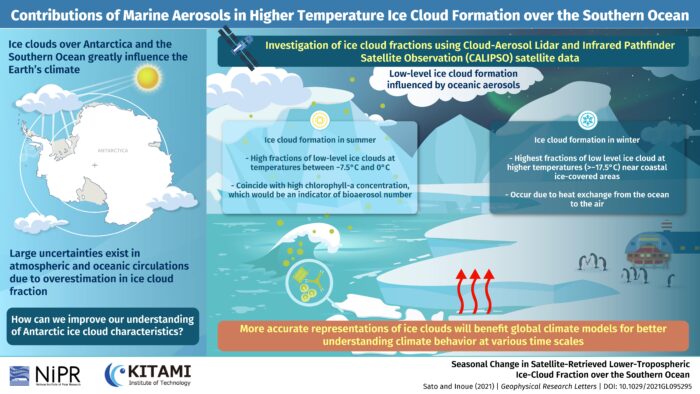
As marine phytoplankton blooms are considered a source of bioaerosols, the scientists also used the satellite data to measure the concentration of chlorophyll on the sea surface to provide an indicator of phytoplankton abundance in the upper layers of the ocean. Finally, they reanalyzed the existing data to understand the extent of gas and particle exchange between the ocean and atmosphere.

They found that there was a sizeable difference in ice cloud formation at the low- and mid-levels (6,500–20,000ft) between summertime and winter. High fractions of low-level ice clouds were observed at comparatively high temperatures (above -7.5°C) over coastal Antarctic Sea ice areas in the summer. This increased ice cloud cover coincided with the highest estimated populations of phytoplankton. In winter, low-level ice clouds were observed at temperatures above -17.5°C, a time during which substantial heat exchange took place from the ocean to the air near coastal areas.

Professor Sato said, “Our findings suggest that marine aerosols emitted from the ocean contribute to low-level ice-cloud formation over the Southern Ocean even under higher temperatures.

“Developing reliable global climate models are essential to improving our understanding and predictions of climate behavior. By clarifying the relationship between ice clouds and marine aerosols, our study will help reduce the errors associated with cloud biases in a numerical climate model.”

The complete findings from the research have been published in the journal Geophysical Research Letters.

Previous ArticleLightning activity dropped 8% during 2020 lockdowns, finds report
Next Article NASA unveils details of four Earth science missions set to launch in 2022

Read Similar Stories

Data

Atmospheric G2 secures Japan weather forecasting license

April 21, 20262 Mins Read
Climate Measurement

China completes Antarctic meteorological research mission with Xuelong icebreaker

April 21, 20262 Mins Read
Space Weather

Northumbria University secures £4m to study Earth’s radiation belts

April 16, 20262 Mins Read
Latest News

Extreme heat posing significant risks to ecosystems and agriculture, FAO-WMO report warns

April 22, 2026

Atmospheric G2 secures Japan weather forecasting license

April 21, 2026

China completes Antarctic meteorological research mission with Xuelong icebreaker

April 21, 2026

Receive breaking stories and features in your inbox each week, for free


Enter your email address:


Supplier Spotlights
  • Nel Hydrogen
Getting in Touch
  • Contact Us / Advertise
  • Meet the Editors
  • Media Pack
  • Free Weekly E-Newsletter
Our Social Channels
  • Facebook
  • LinkedIn
© 2026 UKi Media & Events a division of UKIP Media & Events Ltd
  • Cookie Policy
  • Privacy Policy
  • Terms and Conditions
  • Notice and Takedown Policy

Type above and press Enter to search. Press Esc to cancel.