


Close Menu
Meteorological Technology International
  • News
    • A-E
      • Agriculture
      • Automated Weather Stations
      • Aviation
      • Climate Measurement
      • Data
      • Developing Countries
      • Digital Applications
      • Early Warning Systems
      • Extreme Weather
    • G-P
      • Hydrology
      • Lidar
      • Lightning Detection
      • New Appointments
      • Nowcasting
      • Numerical Weather Prediction
      • Polar Weather
    • R-S
      • Radar
      • Rainfall
      • Remote Sensing
      • Renewable Energy
      • Satellites
      • Solar
      • Space Weather
      • Supercomputers
    • T-Z
      • Training
      • Transport
      • Weather Instruments
      • Wind
      • World Meteorological Organization
      • Meteorological Technology World Expo
  • Features
  • Online Magazines
    • January 2026
    • April 2025
    • January 2025
    • September 2024
    • April 2024
    • Archive Issues
    • Subscribe Free!
  • Opinion
  • Videos
  • Supplier Spotlight
  • Expo
LinkedIn X (Twitter) Facebook
  • Sign-up for Free Weekly E-Newsletter
  • Meet the Editors
  • Contact Us
  • Media Pack
LinkedIn Facebook
Subscribe
Meteorological Technology International
  • News
      • Agriculture
      • Automated Weather Stations
      • Aviation
      • Climate Measurement
      • Data
      • Developing Countries
      • Digital Applications
      • Early Warning Systems
      • Extreme Weather
      • Hydrology
      • Lidar
      • Lightning Detection
      • New Appointments
      • Nowcasting
      • Numerical Weather Prediction
      • Polar Weather
      • Radar
      • Rainfall
      • Remote Sensing
      • Renewable Energy
      • Satellites
      • Solar
      • Space Weather
      • Supercomputers
      • Training
      • Transport
      • Weather Instruments
      • Wind
      • World Meteorological Organization
      • Meteorological Technology World Expo
  • Features
  • Online Magazines
    1. April 2026
    2. January 2026
    3. September 2025
    4. April 2025
    5. January 2025
    6. September 2024
    7. April 2024
    8. January 2024
    9. Archive Issues
    10. Subscribe Free!
    Featured
    May 5, 2026

    In this Issue – April 2026

    By Web TeamMay 5, 2026
    Recent

    In this Issue – April 2026

    May 5, 2026

    In this Issue – January 2026

    November 27, 2025

    In this Issue – September 2025

    August 11, 2025
  • Opinion
  • Videos
  • Supplier Spotlight
  • Expo
Facebook LinkedIn
Subscribe
Meteorological Technology International
Satellites

ESA contracts Open Cosmos to help develop space weather satellite constellation

Dan SymondsBy Dan SymondsJune 7, 20223 Mins Read
Share LinkedIn Facebook Twitter Email
Share
LinkedIn Facebook Twitter Email

UK satellite developer Open Cosmos has secured a €5.2m (US$5.6m) contract with the European Space Agency (ESA) to de-risk the critical elements of a small satellite constellation being launched to monitor space weather.

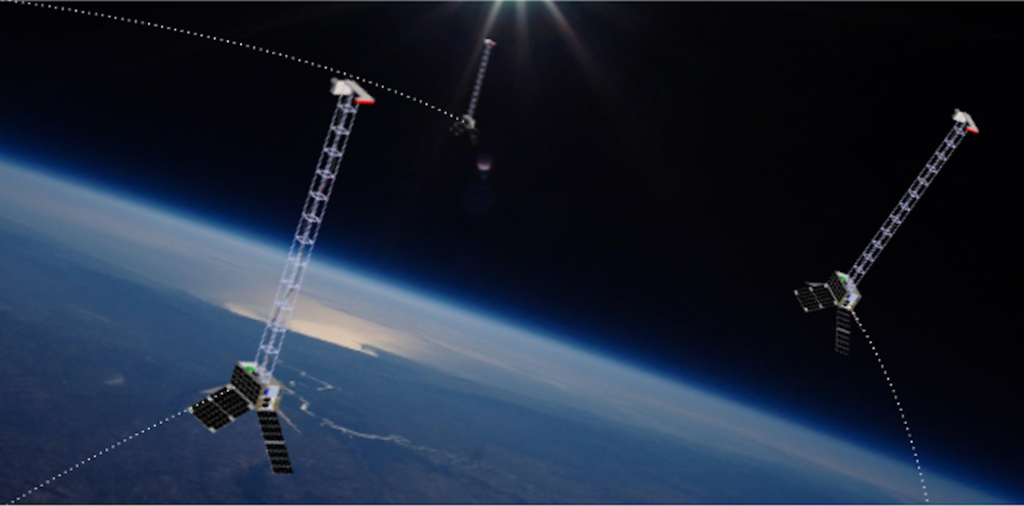
The NanoMagSat mission concept consist of a small satellite constellation to monitor the Earth’s magnetic field and ionospheric environment with an innovative revisiting time strategy and combination of instruments. This includes a self-calibrated absolute scalar/vector magnetometer combined with star trackers on an optical bench; a high-frequency vector magnetometer; a multi-needle Langmuir probe and two dual frequency GNSS receivers for recovery of Total Electron Content and ionospheric radio-occultation data.

The mission consortium comprises Open Cosmos, which is responsible for the satellite and mission concept aspects; the French technology research institute CEA-Leti to oversee the payload and develop the magnetometers; University of Oslo to provide the Langmuir probes; and Spanish engineering companies Comet Ingenieria and Prosix Engineering to provide the deployable boom and optical bench. The Université Paris Cité’s IPGP, is the scientific lead of the mission.

The NanoMagSat mission aims to be a worthy successor of previous missions such as Oersted and CHAMP and ideally complement and extend the measurements of the electromagnetic field beyond the Swarm mission launched in 2013.

The current ESA Swarm satellites have helped researchers make many scientific discoveries regarding solar storms, the way the magnetic field organizes the magnetosphere and ionosphere, the geology of what’s beneath Antarctica’s ice sheets, and even the migratory patterns of animals.

The consortium believes that the new constellation concept and low-cost small satellites will increase the temporal resolution at which the various components of Earth’s magnetic field can be recovered, as well as providing new ways of sounding the ionospheric environment.

The Earth’s magnetic field protects against damaging incoming energetic charged particles such as those coming from the Sun. The Earth’s magnetic field also organizes the way the near outer space (the magnetosphere) and the ionized upper layers of the atmosphere (the ionosphere) respond to solar activity.

This response can produce strong magnetic signals that can affect ground technology such as power transmission networks or, potentially, internet networks. It can also create radiation hazards affecting satellites in near outer space, and multiple ionospheric perturbations that can severely perturb radio transmissions, radars and GNSS systems – a group of hazards collectively known as space weather hazards.

Florian Deconinck, vice president of institutional partnerships and future missions at Open Cosmos, said, “This contract is a landmark for Open Cosmos and for the NanoMagSat mission concept. It is a concrete step toward making this mission concept feasible which if implemented would complement and expand on the results from renowned missions like Oersted, CHAMP or Swarm. More generally it illustrates how ESA, the industry and academia can work together to show the potential of future micro-satellite constellation missions to significantly contribute toward big scientific challenges.”

Gauthier Hulot, deputy director for science and space at IPGP, Université Paris Cité, said, “It is crucial that monitoring of Earth’s magnetic field and ionospheric environment currently achieved by the ESA Swarm mission is maintained and improved beyond this very successful mission. This contract is a major step towards ensuring NanoMagSat can be launched soon enough to achieve this and demonstrate the possibility of permanently maintaining such observations with the help of low-cost scalable small satellite constellations.”

Previous ArticleCarbon dioxide levels 50% higher than pre-industrial era
Next Article China begins trial operations for Fengyun-3E and Fengyun-4B meteorological satellites

Read Similar Stories

Satellites

SMILE mission launches to study Earth’s magnetic shield and space weather

May 20, 20263 Mins Read
Videos

VIDEO: Meteosat-12 imagery over Europe and Africa made available via YouTube streams

May 19, 20262 Mins Read
Extreme Weather

Wildfires can create ‘burn scar heat islands’ that alter weather patterns, study finds

May 6, 20263 Mins Read
Latest News

FEATURE: Turning contrail science into flight plans

May 27, 2026

Vaisala launches AWS810 Airport Edition automatic weather station

May 26, 2026

R.M. Young Company reengineers SNOdar snow-depth sensor

May 21, 2026

Receive breaking stories and features in your inbox each week, for free


Enter your email address:


Supplier Spotlights
  • Adolf Thies GmbH & Co. KG
Getting in Touch
  • Contact Us / Advertise
  • Meet the Editors
  • Media Pack
  • Free Weekly E-Newsletter
Our Social Channels
  • Facebook
  • LinkedIn
© 2026 UKi Media & Events a division of UKIP Media & Events Ltd
  • Cookie Policy
  • Privacy Policy
  • Terms and Conditions
  • Notice and Takedown Policy

Type above and press Enter to search. Press Esc to cancel.