

Close Menu
Meteorological Technology International
  • News
    • A-E
      • Agriculture
      • Automated Weather Stations
      • Aviation
      • Climate Measurement
      • Data
      • Developing Countries
      • Digital Applications
      • Early Warning Systems
      • Extreme Weather
    • G-P
      • Hydrology
      • Lidar
      • Lightning Detection
      • New Appointments
      • Nowcasting
      • Numerical Weather Prediction
      • Polar Weather
    • R-S
      • Radar
      • Rainfall
      • Remote Sensing
      • Renewable Energy
      • Satellites
      • Solar
      • Space Weather
      • Supercomputers
    • T-Z
      • Training
      • Transport
      • Weather Instruments
      • Wind
      • World Meteorological Organization
      • Meteorological Technology World Expo
  • Features
  • Online Magazines
    • January 2026
    • April 2025
    • January 2025
    • September 2024
    • April 2024
    • Archive Issues
    • Subscribe Free!
  • Opinion
  • Videos
  • Supplier Spotlight
  • Expo
LinkedIn X (Twitter) Facebook
  • Sign-up for Free Weekly E-Newsletter
  • Meet the Editors
  • Contact Us
  • Media Pack
LinkedIn Facebook
Subscribe
Meteorological Technology International
  • News
      • Agriculture
      • Automated Weather Stations
      • Aviation
      • Climate Measurement
      • Data
      • Developing Countries
      • Digital Applications
      • Early Warning Systems
      • Extreme Weather
      • Hydrology
      • Lidar
      • Lightning Detection
      • New Appointments
      • Nowcasting
      • Numerical Weather Prediction
      • Polar Weather
      • Radar
      • Rainfall
      • Remote Sensing
      • Renewable Energy
      • Satellites
      • Solar
      • Space Weather
      • Supercomputers
      • Training
      • Transport
      • Weather Instruments
      • Wind
      • World Meteorological Organization
      • Meteorological Technology World Expo
  • Features
  • Online Magazines
    1. April 2026
    2. January 2026
    3. September 2025
    4. April 2025
    5. January 2025
    6. September 2024
    7. April 2024
    8. January 2024
    9. Archive Issues
    10. Subscribe Free!
    Featured
    May 5, 2026

    In this Issue – April 2026

    By Web TeamMay 5, 2026
    Recent

    In this Issue – April 2026

    May 5, 2026

    In this Issue – January 2026

    November 27, 2025

    In this Issue – September 2025

    August 11, 2025
  • Opinion
  • Videos
  • Supplier Spotlight
  • Expo
Facebook LinkedIn
Subscribe
Meteorological Technology International
Satellites

ESA weather satellite’s near miss warns of dangers to come

Paul WillisBy Paul WillisSeptember 17, 20193 Mins Read
Share LinkedIn Facebook Twitter Email
Image: ESA
Share
LinkedIn Facebook Twitter Email

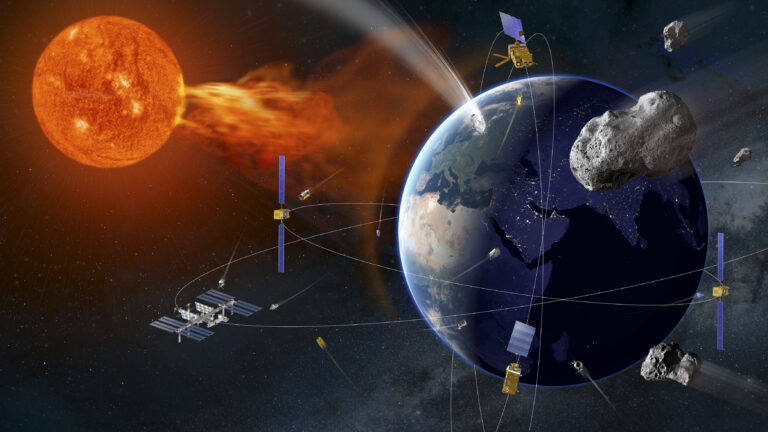
A weather satellite belonging to the European Space Agency (ESA) was forced into a last-minute maneuver to avoid colliding with another satellite in a large constellation, in a first for the agency.

The ESA performed what it called a “collision avoidance maneuver”, firing the thrusters of its Aelous observation satellite to move it off a course from a potential direct hit with a SpaceX satellite in the Starlink constellation.

The agency said it was first notified of the threat in late August by the 18th Space Control Squadron of the US Air Force, which monitors objects traveling in Earth’s orbit.

The US data predicted a “conjunction” on September 2 between Aelous, which was launched 12 months ago to monitor wind speeds on Earth, and the recently launched Starlink44, part of SpaceX’s mega constellation, which is planned to grow to a 12,000 strong fleet by mid-2020.

According to the ESA, staff in its Space Debris office monitored the situation for several days and as the collision probability grew they contacted SpaceX to discuss what could be done.

After SpaceX informed the ESA it had no plan to take action, the ESA decided to fire the thrusters on its satellite half an orbit before the potential collision. Commands were sent to the spacecraft from ESA mission control in Germany and it was maneuvered to a position 350m above its previous orbit, comfortably out of reach of Starlink44.

“This example shows that in the absence of traffic rules and communication protocols, collision avoidance depends entirely on the pragmatism of the operators involved,” said Holger Krag, head of space safety at the ESA. “Today this negotiation is done through exchanging emails – an archaic process that is no longer viable as increasing numbers of satellites in space mean more space traffic.”

According to the ESA there are about 9,000 satellites in orbit, with only about 2,000 operational. The other 7,000 are inactive and orbiting as space debris. Consequently 90% of ESA’s avoidance maneuvers until now have been as a result of space debris.

The Aeolus incident was the first near miss for the agency involving a satellite from a mass constellation. But as commercial space ventures like SpaceX populate Earth’s orbit with more satellites, the need for a more comprehensive avoidance system increases as the risk of collision grows.

With this in mind, the ESA is planning to replace its current manual processes with a fully automated system that will leverage artificial intelligence to protect the agency’s assets.

“No one was at fault here, but this example does show the urgent need for proper space traffic management, with clear communication protocols and more automation,” says Holger. “This is how air traffic control has worked for many decades, and now space operators need to get together to define automated maneuver coordination.”

Previous ArticleNew forecasting model predicts when vehicles will overturn
Next Article US scientists deploy AI for nowcasting of hurricanes

Read Similar Stories

Satellites

SMILE mission launches to study Earth’s magnetic shield and space weather

May 20, 20263 Mins Read
Videos

VIDEO: Meteosat-12 imagery over Europe and Africa made available via YouTube streams

May 19, 20262 Mins Read
Extreme Weather

Wildfires can create ‘burn scar heat islands’ that alter weather patterns, study finds

May 6, 20263 Mins Read
Latest News

SMILE mission launches to study Earth’s magnetic shield and space weather

May 20, 2026

Cloud measurement campaign targets improved climate model accuracy

May 20, 2026

VIDEO: Meteosat-12 imagery over Europe and Africa made available via YouTube streams

May 19, 2026

Receive breaking stories and features in your inbox each week, for free


Enter your email address:


Supplier Spotlights
  • EWR Radar Systems
Getting in Touch
  • Contact Us / Advertise
  • Meet the Editors
  • Media Pack
  • Free Weekly E-Newsletter
Our Social Channels
  • Facebook
  • LinkedIn
© 2026 UKi Media & Events a division of UKIP Media & Events Ltd
  • Cookie Policy
  • Privacy Policy
  • Terms and Conditions
  • Notice and Takedown Policy

Type above and press Enter to search. Press Esc to cancel.