


Close Menu
Meteorological Technology International
  • News
    • A-E
      • Agriculture
      • Automated Weather Stations
      • Aviation
      • Climate Measurement
      • Data
      • Developing Countries
      • Digital Applications
      • Early Warning Systems
      • Extreme Weather
    • G-P
      • Hydrology
      • Lidar
      • Lightning Detection
      • New Appointments
      • Nowcasting
      • Numerical Weather Prediction
      • Polar Weather
    • R-S
      • Radar
      • Rainfall
      • Remote Sensing
      • Renewable Energy
      • Satellites
      • Solar
      • Space Weather
      • Supercomputers
    • T-Z
      • Training
      • Transport
      • Weather Instruments
      • Wind
      • World Meteorological Organization
      • Meteorological Technology World Expo
  • Features
  • Online Magazines
    • January 2026
    • April 2025
    • January 2025
    • September 2024
    • April 2024
    • Archive Issues
    • Subscribe Free!
  • Opinion
  • Videos
  • Supplier Spotlight
  • Expo
LinkedIn X (Twitter) Facebook
  • Sign-up for Free Weekly E-Newsletter
  • Meet the Editors
  • Contact Us
  • Media Pack
LinkedIn Facebook
Subscribe
Meteorological Technology International
  • News
      • Agriculture
      • Automated Weather Stations
      • Aviation
      • Climate Measurement
      • Data
      • Developing Countries
      • Digital Applications
      • Early Warning Systems
      • Extreme Weather
      • Hydrology
      • Lidar
      • Lightning Detection
      • New Appointments
      • Nowcasting
      • Numerical Weather Prediction
      • Polar Weather
      • Radar
      • Rainfall
      • Remote Sensing
      • Renewable Energy
      • Satellites
      • Solar
      • Space Weather
      • Supercomputers
      • Training
      • Transport
      • Weather Instruments
      • Wind
      • World Meteorological Organization
      • Meteorological Technology World Expo
  • Features
  • Online Magazines
    1. January 2026
    2. September 2025
    3. April 2025
    4. January 2025
    5. September 2024
    6. April 2024
    7. January 2024
    8. September 2023
    9. April 2023
    10. Archive Issues
    11. Subscribe Free!
    Featured
    November 27, 2025

    In this Issue – January 2026

    By Hazel KingNovember 27, 2025
    Recent

    In this Issue – January 2026

    November 27, 2025

    In this Issue – September 2025

    August 11, 2025

    In this Issue – April 2025

    April 15, 2025
  • Opinion
  • Videos
  • Supplier Spotlight
  • Expo
Facebook LinkedIn
Subscribe
Meteorological Technology International
Hydrology

SWOT satellite hardware transported from USA to France to complete build

Helen NormanBy Helen NormanJuly 1, 20213 Mins Read
Share LinkedIn Facebook Twitter Email
NASA SWOT
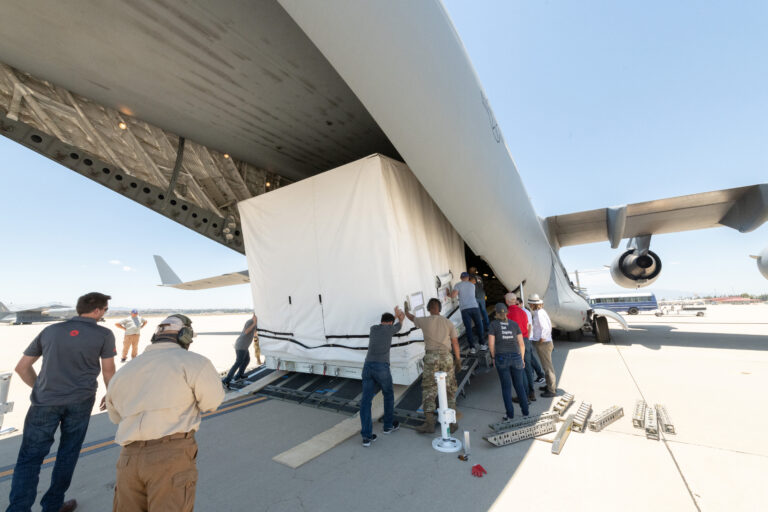
Teams from NASA’s Jet Propulsion Laboratory in Southern California and the March Air Reserve Base in Riverside County, California, loaded the scientific payload for the SWOT Earth-observing satellite into a C-17 airplane on June 27. Image:  NASA/JPL-Caltech
Share
LinkedIn Facebook Twitter Email

The Surface Water and Ocean Topography (SWOT) mission, a collaboration between NASA and the French space agency Centre National d’Etudes Spatial (CNES), took a step forward this week when a team at NASA’s Jet Propulsion Laboratory (JPL) in Southern California, USA, shipped the scientific heart of the satellite to France.

A US Air Force C-17 airplane carrying the hardware, which includes finely tuned research instruments, left March Air Reserve Base in Riverside County, California, on June 27. It arrived on June 30 at a Thales Alenia Space clean room facility near Cannes, France, where engineers and technicians will spend the next year integrating the hardware with the rest of the satellite.

Once done, SWOT will make the journey back to California, where it will launch atop a SpaceX Falcon 9 rocket from Vandenberg Air Force Base no earlier than November 2022. “Now that the payload is in France, we’re a major step closer to finishing this satellite and getting to launch,” said Parag Vaze, SWOT project manager at JPL.

The SWOT mission will help scientists monitor the Earth’s ocean, as well as the amount of fresh water in its lakes and rivers. The SUV-size spacecraft will make global surveys of Earth’s surface water. By measuring its height, researchers can track the volume and location of the finite resource around the world. The data will help with monitoring changes in flood plains and wetlands, measure how much fresh water flows into and out of lakes and rivers and back to the ocean, and track regional shifts in sea level.

The information SWOT will provide on small-scale ocean currents will also support real-time ocean activities like shipping that are affected by tides, currents, storm surges, and other natural phenomena. And SWOT data will provide, for the first time, global observations of how circular currents, called eddies, affect how the ocean stores heat and releases it into the atmosphere, as well as how carbon moves through the marine environment.

SWOT is being jointly developed by NASA and CNES, with contributions from the Canadian Space Agency and UK Space Agency (UKSA). JPL, which is managed for NASA by Caltech in Pasadena, California, leads the US component of the project. For the flight system payload, NASA is providing the Ka-band Radar Interferometer (KaRIn) instrument, a GPS science receiver, a laser retroreflector, and a two-beam microwave radiometer.

Meanwhile, CNES is providing the Doppler Orbitography and Radiopositioning Integrated by Satellite (DORIS) system, nadir altimeter, and the KaRIn RF subsystem (with support from the UKSA). CSA is providing the KaRIn high-power transmitter assembly. NASA is providing associated launch services.

Previous ArticleVaisala launches new air quality sensor and monitoring solution
Next Article UK Met Office aims to be a net zero emitter by 2030

Read Similar Stories

Early Warning Systems

China expands MAZU early warning system for developing countries

April 30, 20262 Mins Read
Space Weather

Northumbria University secures £4m to study Earth’s radiation belts

April 16, 20262 Mins Read
Extreme Weather

AI model improves real-time prediction of wildfire spread

April 16, 20263 Mins Read
Latest News

Researchers investigate links between air pollution, extreme weather and climate

May 1, 2026

China expands MAZU early warning system for developing countries

April 30, 2026

Météo-France begins construction of France’s tallest weather radar tower in Sembadel

April 29, 2026

Receive breaking stories and features in your inbox each week, for free


Enter your email address:


Supplier Spotlights
  • EUMETSAT
Getting in Touch
  • Contact Us / Advertise
  • Meet the Editors
  • Media Pack
  • Free Weekly E-Newsletter
Our Social Channels
  • Facebook
  • LinkedIn
© 2026 UKi Media & Events a division of UKIP Media & Events Ltd
  • Cookie Policy
  • Privacy Policy
  • Terms and Conditions
  • Notice and Takedown Policy

Type above and press Enter to search. Press Esc to cancel.