


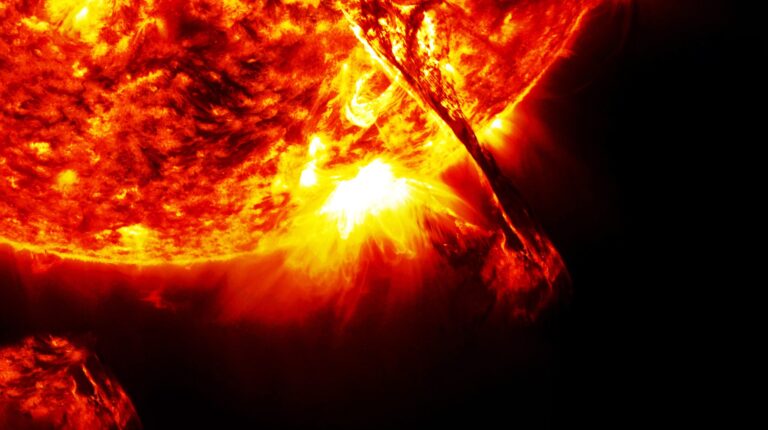
Researchers at the US National Science Foundation National Center for Atmospheric Research (NSF NCAR) and Southwest Research Institute (SwRI) say that they have developed a new tool capable of advancing the forecasting of space weather, so that events could be projected weeks in advance instead of just hours.
The breakthrough could bring significant benefits to agencies and industries, mitigating impacts to GPS, power grids, astronaut safety and more.
The research team’s newly published research highlights a tool they developed called PINNBARDS (PINN-Based Active Regions Distribution Simulator), which they say is capable of bridging surface observations of solar active regions and deep solar magnetic dynamics.
The PINNBARDS framework brings together physics-informed, AI-enabled forecasting tools to strengthen understanding and anticipation of extreme space weather. It is said to offer the potential for significantly longer forecast lead times, thereby strengthening safeguards for satellites, communications infrastructure and future human space exploration.
“The reconstructed subsurface states from PINNBARDS provide initial conditions for forward simulations of solar magnetic evolution, opening the door to predicting where and when large, flare-producing active regions are likely to emerge weeks in advance,” said Mausumi Dikpati, NSF NCAR senior scientist, who led the team and co-authored the paper.
The team used the Derecho supercomputer at the NSF NCAR-Wyoming Supercomputer Center to run the simulations for the research. It was funded by NASA’s Heliophysics Guest Investigator Open (HGIO) program and Consequences of Fields and Flows in the Interior and Exterior of the SUN (COFFIES) DRIVE Center, a NASA-funded initiative where Dikpati is a co-investigator.
Todd Hoeksema, Stanford University professor and the lead of the COFFIES DRIVE Center, said that one of COFFIES aims is to predict where and when the Sun will produce its next “big, flare-generating active region.”
“By combining physics-based modeling with AI, this work lets us peer beneath the Sun’s surface and reconstruct the magnetic conditions that give rise to those regions,” he said.
Related news, NASA makes IMAP real-time space weather data link available