


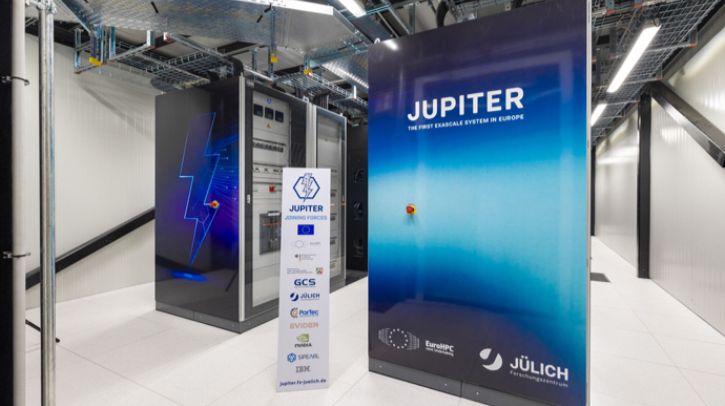
The European Centre for Medium-Range Weather Forecasts (ECMWF) has said that Europe’s first exascale supercomputer, Jupiter, can bring a “fundamental step-change” to the products it delivers, after the system went into operation on September 5.
Jupiter is designed to be Europe’s first supercomputer capable of reaching exascale performance, meaning it can achieve at least one exaflop – one quintillion (1018) calculations per second. It is the fourth most powerful supercomputer in the world.
Director of forecasts and services and ECMWF’s director-general elect, Florian Pappenberger, said, “It is very important that Europe is entering the era of exascale computing. We are in exciting times for numerical weather prediction, with unprecedented developments in artificial intelligence and machine learning. At the same time, we are witnessing technology achievements such as Jupiter that put in our hands extraordinary computing power.
“Combined with new observation capabilities and the fast-evolving scientific developments in the areas of weather and climate, this computer power will mark a fundamental step-change in the products we deliver to our member states and partners,” he concluded.
“We are very happy to have this opportunity to pioneer the use of this incredible machine,” commented Nils Wedi, digital technology lead for Destination Earth at ECMWF. “We’ve already managed to run the first numerical weather prediction simulations with both our Integrated Forecasting System (IFS) and Artificial Intelligence Forecasting System (AIFS) on Jupiter.”
According to ECMWF, the computing power will enable the performance of global kilometer (km) scale simulations, matching the resolution of the latest generation of EUMETSAT’s Meteosat Third Generation-Imager (MTG-I) and the Meteosat Third Generation Sounder (MTG-S).
The simulations will provide the opportunity to run the full GPU port of the IFS model for the first time, with insights to improve the scalability of the model components at extreme scales.
The proposal submitted to the Jupiter exascale supercomputer meets the World Meteorological Organization (WMO) scientific advisory panel recommendations for advancing km-scale modeling and the exploitation of observations in addressing systematic errors, and also advances the ability to predict weather in a changing climate – in particular, for extreme events.
Peter Düben, head of earth system modeling at ECMWF, highlighted the importance of the Jupiter exascale for advancing weather and climate modeling. “We are currently witnessing significant changes in the field of Earth system modeling, as machine learning is changing the way numerical weather forecasting is done,” he said. “It is, therefore, essential that machines like Jupiter provide Europe with sufficient compute power to develop large machine learning models such as ECMWF’s AIFS to secure Europe’s world-leading position in weather and climate modeling.”