


Close Menu
Meteorological Technology International
  • News
    • A-E
      • Agriculture
      • Automated Weather Stations
      • Aviation
      • Climate Measurement
      • Data
      • Developing Countries
      • Digital Applications
      • Early Warning Systems
      • Extreme Weather
    • G-P
      • Hydrology
      • Lidar
      • Lightning Detection
      • New Appointments
      • Nowcasting
      • Numerical Weather Prediction
      • Polar Weather
    • R-S
      • Radar
      • Rainfall
      • Remote Sensing
      • Renewable Energy
      • Satellites
      • Solar
      • Space Weather
      • Supercomputers
    • T-Z
      • Training
      • Transport
      • Weather Instruments
      • Wind
      • World Meteorological Organization
      • Meteorological Technology World Expo
  • Features
  • Online Magazines
    • January 2026
    • April 2025
    • January 2025
    • September 2024
    • April 2024
    • Archive Issues
    • Subscribe Free!
  • Opinion
  • Videos
  • Supplier Spotlight
  • Expo
LinkedIn X (Twitter) Facebook
  • Sign-up for Free Weekly E-Newsletter
  • Meet the Editors
  • Contact Us
  • Media Pack
LinkedIn Facebook
Subscribe
Meteorological Technology International
  • News
      • Agriculture
      • Automated Weather Stations
      • Aviation
      • Climate Measurement
      • Data
      • Developing Countries
      • Digital Applications
      • Early Warning Systems
      • Extreme Weather
      • Hydrology
      • Lidar
      • Lightning Detection
      • New Appointments
      • Nowcasting
      • Numerical Weather Prediction
      • Polar Weather
      • Radar
      • Rainfall
      • Remote Sensing
      • Renewable Energy
      • Satellites
      • Solar
      • Space Weather
      • Supercomputers
      • Training
      • Transport
      • Weather Instruments
      • Wind
      • World Meteorological Organization
      • Meteorological Technology World Expo
  • Features
  • Online Magazines
    1. January 2026
    2. September 2025
    3. April 2025
    4. January 2025
    5. September 2024
    6. April 2024
    7. January 2024
    8. September 2023
    9. April 2023
    10. Archive Issues
    11. Subscribe Free!
    Featured
    November 27, 2025

    In this Issue – January 2026

    By Hazel KingNovember 27, 2025
    Recent

    In this Issue – January 2026

    November 27, 2025

    In this Issue – September 2025

    August 11, 2025

    In this Issue – April 2025

    April 15, 2025
  • Opinion
  • Videos
  • Supplier Spotlight
  • Expo
Facebook LinkedIn
Subscribe
Meteorological Technology International
Satellites

NASA imagery captures height of smoke plumes from California wildfires

Dan SymondsBy Dan SymondsAugust 25, 20211 Min Read
Share LinkedIn Facebook Twitter Email
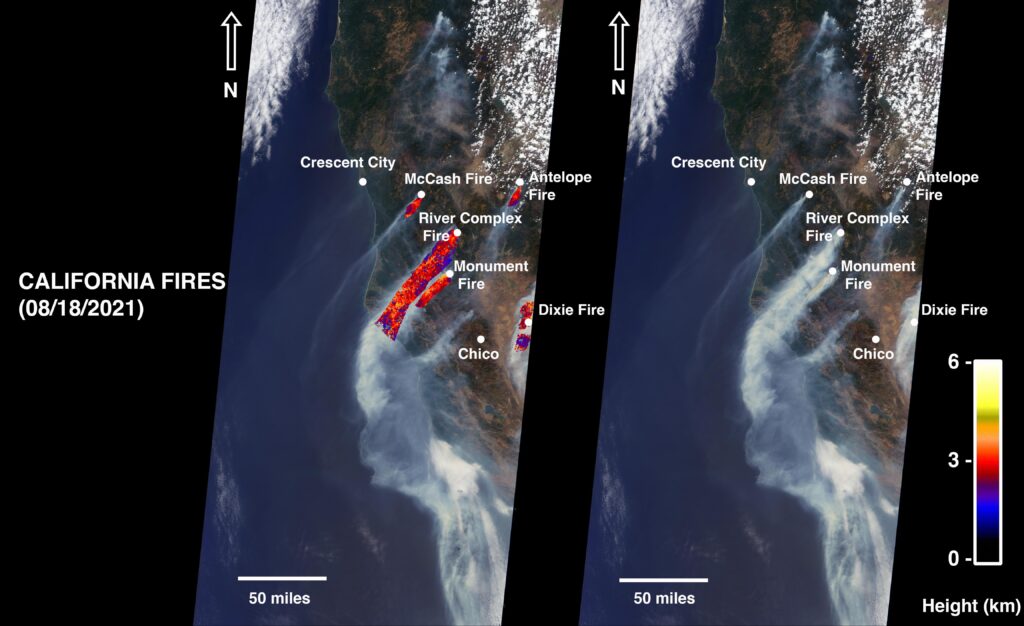
MISR wildfire imagery (credit: NASA/GSFC/LaRC/JPL-Caltech, MISR Team)
Share
LinkedIn Facebook Twitter Email

NASA’s Multi-angle Imaging SpectroRadiometer (MISR) has detected and captured giant smoke plumes originating from the recent wildfires spreading across northern California.

Fixed aboard NASA’s Terra satellite, MISR captured smoke from the McCash, Antelope, River Complex, Monument and Dixie fires, which have scorched more than 4,000km2  of land between them. The Dixie Fire, the state’s second largest in history, accounts for 2,960km2.

The MISR instrument has nine cameras that view Earth at different angles. The multi-angular information from MISR’s images is used to calculate the height of the smoke plumes.

Analysis of the imagery showed that the highest plume reached approximately 6,000m. In general, higher-altitude plumes transport smoke greater distances from the source, impacting communities downwind. In recent weeks, smoke from fires in Western USA and Canada has impacted much of the East Coast.

MISR was built and is managed by NASA’s Jet Propulsion Laboratory in Pasadena, California, for NASA’s Science Mission Directorate in Washington. The smoke plume height calculation was performed using the publicly available MISR INteractive eXplorer (MINX) software tool. The MISR Plume Height Project maintains a database of global smoke plume heights.

Previous ArticleTaiwan to work with Guatemala to improve extreme weather forecasting abilities
Next Article Mantle Labs partners with Spire Global to power advanced weather warnings for agriculture

Read Similar Stories

Space Weather

Northumbria University secures £4m to study Earth’s radiation belts

April 16, 20262 Mins Read
Extreme Weather

AI model improves real-time prediction of wildfire spread

April 16, 20263 Mins Read
Satellites

AI tool uses weather satellite data to map ocean currents in near real time

April 14, 20263 Mins Read
Latest News

Extreme heat posing significant risks to ecosystems and agriculture, FAO-WMO report warns

April 22, 2026

Atmospheric G2 secures Japan weather forecasting license

April 21, 2026

China completes Antarctic meteorological research mission with Xuelong icebreaker

April 21, 2026

Receive breaking stories and features in your inbox each week, for free


Enter your email address:


Supplier Spotlights
  • Sommer GmbH
Getting in Touch
  • Contact Us / Advertise
  • Meet the Editors
  • Media Pack
  • Free Weekly E-Newsletter
Our Social Channels
  • Facebook
  • LinkedIn
© 2026 UKi Media & Events a division of UKIP Media & Events Ltd
  • Cookie Policy
  • Privacy Policy
  • Terms and Conditions
  • Notice and Takedown Policy

Type above and press Enter to search. Press Esc to cancel.