


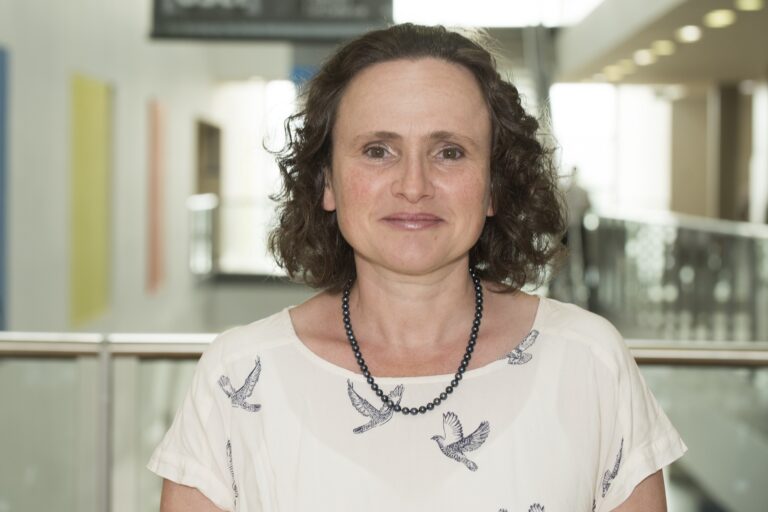
The UK Met Office’s new chief exec looks to capitalize on the organization’s technological capabilities
In December 2018, Prof. Penelope Endersby became the first female chief executive to take the reins at the UK Met Office. She joins the organization from the Defence Science and Technology Laboratory (Dstl) – an executive agency of the UK’s Ministry of Defence – where she led the Cyber and Information Systems Division. With key specialisms in computer science and electronics, Endersby will lead the organization in a new era of cloud computing and big data.
Tell us a little about your career to date.
I studied physics at Cambridge University and researched fuel cells at British Gas before embarking on a 25-year career in the defense industry. My particular research expertise was in novel armor technologies. I led Dstl’s physical sciences department, before making the switch to leading the cyber and information division in 2012, when this was becoming a key focus for defense and security. I’m a visiting professor in electronics and computer science at Southampton University with a particular interest in innovation and entrepreneurship.
Why did you decide to move into the meteorological industry?
I’d been searching for the right opportunity for a while, and this was the perfect combination that allowed me to maintain my technical interest and scale up my leadership, all focused on something that really makes a difference to people’s lives. Deciding to apply took seconds, and I was thrilled to be offered the job.
What interests you most about this sector?
Weather touches almost all aspects of our lives, and personally, I have always been a bit of a weather geek. Moreover, there has never been a time when climate research has been more important to humankind. I care deeply for the natural environment and until recently was a trustee of Wiltshire Wildlife Trust. There is some fascinating new science to get to grips with too, with some of the biggest big data around.
What will your main objectives be as chief executive?
Our purpose is to work at the forefront of weather and climate research for protection, prosperity and well-being. It’s core to my role to ensure we maintain our world-leading status into the future and continue to deliver the benefits the taxpayer is entitled to expect from the investment made. I also have a significant international role, including working with my opposite numbers from Météo France and Deutscher Wetterdienst. Weather and climate are inherently global and cooperation between nations is key to improving forecasts and climate understanding.
What do you believe are the key challenges facing the Met Office?
In common with all national met services we depend on our supercomputer, and the ongoing increase in compute power to run increasingly complex models. We’ve been relying on Moore’s Law to deliver this increase for us for decades, but it is no longer progressing at the same rate. The next generation of supercomputers is likely to look quite different to today’s machines, and adapting to this change will require a complete rewrite of our modeling codes. We will also need to find subtle new ways to keep building our forecast capability, at the same time as demonstrating return on what is likely to be an increasing investment through continually improving services to public and commercial customers.
How can the met industry better embrace new technologies to improve service levels?
It will come down to working with our customers to target our advice and guidance to add value for their particular needs. We are adept at manipulating big data, but we expect to make increasing use of artificial intelligence (AI) and machine learning to find new ways to create value for customers. We are already shaping our research to, for example, address the challenge of local fog forecasting for aviation. Digital providers have been very smart in tailoring simple products to individual interests and there may be more we can learn from them, both for industry customers and for the forecasts we provide to the public.
What do you hope to achieve within the organization?
I am really interested in the whole journey of our science. That means ensuring we have a strong pipeline of innovative ideas at the early stages, and that we extract every bit of value from our research as we develop
it and then pull it through into the weather and climate forecasts that are our core products. A good range of ideas comes from having the right talent and working with the right partners. The Met Office is committed to diversity in all its guises and we’ve made some great strides on gender equality. I think we could do more to attract a wider ethnic and social mix and that will be an early focus.
What do you believe the next few years will hold for the Met Office?
I expect my tenure as chief executive to cover the time when ordinary people begin to experience the impacts of a warming climate on their lives, and that this will become a much more visible issue. We’re proud that the UK government has invested in world-leading climate research since our Hadley Centre for Climate Science and Services was founded in 1990, so we’re well placed to advise. We have just delivered our 2018 UK climate predictions (UKCP18), which are the most comprehensive picture yet of how the UK climate could change over the next century. They are the first major update to the UK’s national climate change projections for nearly 10 years (following UKCP09 in 2009) and illustrate a range of future climate scenarios out to 2100. We’re also increasingly being asked to describe future weather conditions rather than just climate trends. UKCP18 shows an increased chance of milder, wetter winters and hotter, drier summers, along with an increase in the frequency and intensity of extreme weather events. We are already seeing increasing calls for us to be able to attribute extreme weather, such as last summer’s heatwave, to climate change with more certainty and to advise on mitigation. These are very active areas of work for us.
How do you see the meteorological industry evolving in the future?
With open data and increased access to computing power, I expect there to be more commercial players in the market of variable quality. The data available from internet-connected devices will be added to the specialized sources we already use, and the increasing scale of data is already driving us toward cloud computing models, which will surely continue.