


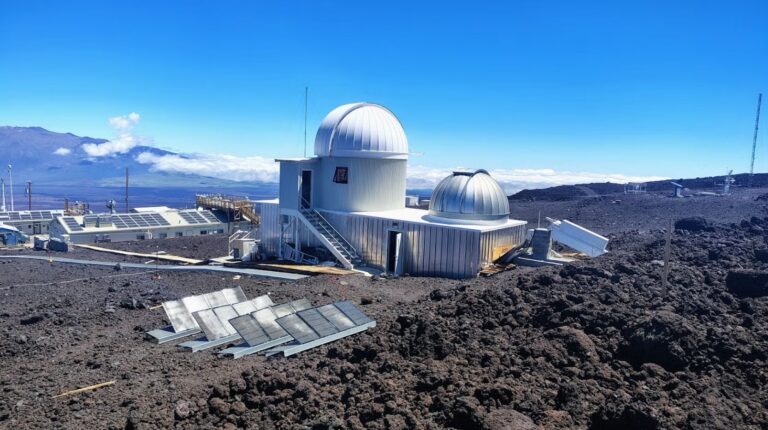
The Mauna Loa Solar Observatory (MLSO) in Hawaii has resumed full operations more than three years after a volcanic eruption cut off road access to the site.
Operated by the US National Science Foundation National Center for Atmospheric Research (NSF NCAR), the observatory had been largely inaccessible since Mauna Loa erupted in November 2022, blocking the main access route with lava flows.
With the road now rebuilt, MLSO is returning to normal operations, including daily on-site staffing, and is set to support NASA’s Artemis II mission by providing early warnings of hazardous space weather.
The observatory, established in 1965 on the slopes of Mauna Loa, is positioned to deliver high-altitude solar observations with minimal atmospheric interference. Its primary role includes monitoring coronal mass ejections (CMEs), which can trigger radiation storms capable of damaging satellites and posing risks to astronauts.
MLSO uses ground-based coronagraphs to detect CMEs and can issue alerts approximately one hour earlier than comparable space-based systems.
During the Artemis II mission – the first crewed lunar flyby in 50 years – the observatory is providing real-time alerts to NASA’s Space Radiation Analysis Group if potentially dangerous solar activity is detected.
Although full operations were suspended following the eruption, MLSO continued limited activity using alternative power sources such as solar panels and generators. In April 2024, scientists were transported by helicopter to conduct observations during a total solar eclipse, collecting data on the Sun’s corona.
With access restored, staff will now be present at the observatory seven days a week during daylight hours to resume continuous monitoring.
The reopening restores a key capability for ground-based solar observation at a time of increased focus on crewed space missions, where accurate and timely space weather forecasting is critical for mission safety.
Read MTI’s exclusive interview with Mausumi Dikpati, NSF NCAR senior scientist here
Related news, NCAR researchers create breakthrough tool to enhance space weather prediction