


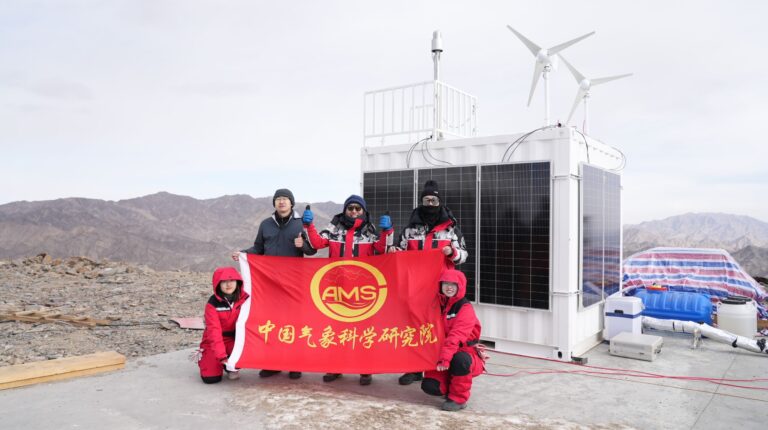
China’s Lenghu Unmanned Atmospheric Background Observation Experiment (CRUX-2.0) has achieved key progress toward automated monitoring systems intended to support future atmospheric observations in Antarctica.
The Chinese Academy of Meteorological Sciences (CAMS), part of the China Meteorological Administration, said the CRUX-2.0 project has successfully demonstrated unmanned and automated monitoring, sampling, calibration and data transmission for atmospheric background observation equipment. The work is designed to provide technical support for long-term monitoring in Antarctica’s inland regions.
Ding Minghu, director and researcher at CAMS’ Institute of Global Change and Polar Meteorology, said the goal is to support observations at China’s Kunlun Station in Antarctica, located at Dome A, one of the continent’s highest inland points. The site is considered suitable for global atmospheric background monitoring, but its harsh environment makes year-round human presence difficult.
To address this, CAMS researchers launched an unmanned observation experiment at the Lenghu Astronomical Observation and Research Base in Qinghai, at an elevation of 4,306m. The site was chosen to simulate conditions similar to those at Kunlun Station, allowing testing of equipment under high-altitude, low-temperature and low-pressure conditions.
Tian Biao, an associate researcher at CAMS and lead for the experiment, said key challenges include ensuring long-term energy supply, environmental stability and reliable data transmission in extreme conditions. “The main challenges of the experiment lie in achieving long-term and stable energy and environmental support, automated data quality control and remote transmission in extreme environments,” he explained.
Launched in November 2025, the project has completed system construction and debugging of four core modules: independent temperature control, independent energy supply, online atmospheric composition monitoring and automatic sampling. CAMS said the system has achieved stable automated operation with automatic data collection, calibration and remote transmission.
The next phase will simulate Antarctic polar night conditions to test energy supply and system stability. Researchers plan to carry out field tests in Antarctica and continue refining the technology to support long-term, continuous monitoring of key atmospheric components.
In related news, China’s Xihe-2 Sun-Earth L5 solar exploration project officially launches