


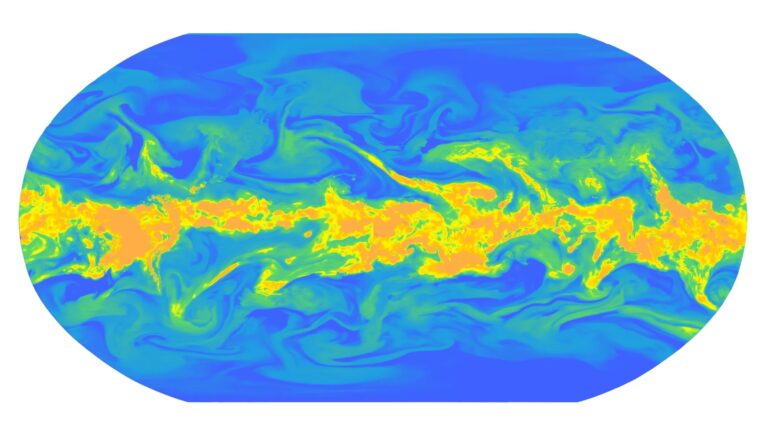
Google DeepMind and Google Research have introduced WeatherNext 2, a new AI-based global forecasting model designed to deliver more efficient, more accurate and higher-resolution predictions across key meteorological variables.
WeatherNext 2 provides forecasts at resolutions down to one hour and can generate hundreds of possible weather scenarios from a single starting point. Each scenario is produced in under a minute on a single tensor processing unity (TPU), a significant computational gain compared with traditional physics-based numerical weather prediction (NWP), which would typically require hours on a supercomputer.
According to Google, WeatherNext 2 surpasses the previous WeatherNext model on 99.9% of variables – including temperature, wind and humidity – and on all lead times between 0 and 15 days.
A central advancement is the use of a new AI modeling approach called a Functional Generative Network (FGN), which injects ‘noise’ directly into the architecture to ensure the forecasts remain physically realistic and interconnected. The approach improves the system’s ability to predict both ‘marginals’ – standalone meteorological elements – and ‘joints’, which describe how these variables interact to form large-scale, complex weather systems. This capability supports applications such as identifying regions affected by high heat or estimating power output across a wind farm.
WeatherNext 2 also marks a shift from research to deployment. Forecast data is now accessible through Google Earth Engine and BigQuery, and an early access program is available on Google Cloud’s Vertex AI for users requiring custom model inference. The system has already been integrated into Search, Gemini, Pixel Weather and the Google Maps Platform Weather API, with broader use across Google Maps expected in the coming weeks.
Google says it is continuing to research improvements, including integrating additional data sources and expanding access for researchers, developers and commercial users. The company states that by providing powerful open tools, it aims to support global scientific collaboration and enable more informed decision-making across industries.
In related news, Arcadis and Jupiter Intelligence partner to accelerate global climate resilience solutions