


The Met Office has achieved significant improvements in maritime forecast accuracy over the past decade, strengthening safety, efficiency and sustainability at sea.
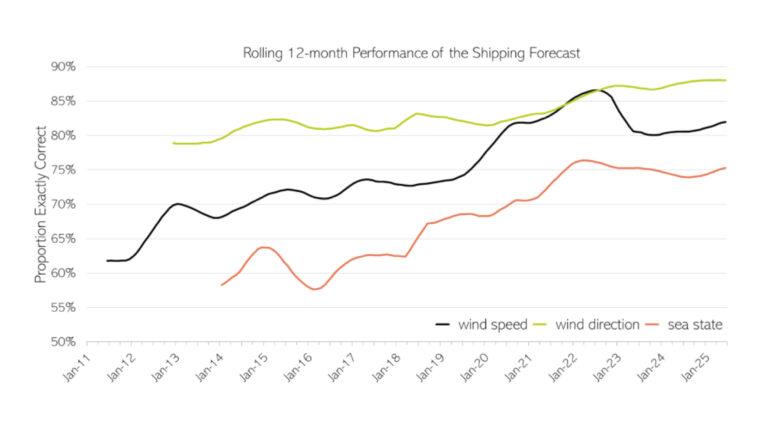
New analysis shows steady gains across the Shipping Forecast’s three core components – wind speed, wind direction and sea state – since 2014. Over that period, wind speed accuracy rose from 72% to 82%, wind direction from 82% to 88%, and sea state from 64% to 75%.
Wind direction remains the most precisely forecast component, while wind speed and sea state have also shown consistent progress. These improvements stem from advances in numerical weather prediction (NWP) and the Shipping Forecast Performance verification system.
Advanced verification and automation
Forecast accuracy is continuously monitored through a rigorous verification process that interprets hand-written forecast text for each named sea area. This near-real-time feedback helps forecasters identify and correct performance trends quickly.
The same verification technology, applicable worldwide, supports the UK’s role in coordinating forecasts across METAREA I, covering the Northeast Atlantic Ocean and the North Sea.
The Met Office has also developed an automated ‘first-draft’ Shipping Forecast system that generates complete forecast text directly from model data. Trials show its accuracy matches that of forecasts produced manually by operational meteorologists, enabling them to concentrate on refining the narrative and highlighting critical details.
Impact on safety and the economy
Accurate marine forecasts underpin safer operations for commercial shipping, fishing and offshore energy sectors. Research published in Natural Hazards and Earth System Sciences found that around 30% of marine accidents can be linked to poor weather, making reliable forecasting a vital safety factor.
“The advancements in forecasting weather and sea states have allowed fishers to reduce the risks they face,” said David Fenner, Head of Fishing Safety at the UK Maritime and Coastguard Agency.
Each improvement in accuracy translates directly to better-informed decisions at sea, enabling operators to maximize efficiency while avoiding hazardous conditions.
AI-assisted forecasting builds on a century of progress
First introduced by Met Office founder Robert FitzRoy in the 19th century, the Shipping Forecast has evolved from telegraphed storm warnings into a modern, data-rich forecasting system.
Today, AI and automation play an increasing role in producing and verifying forecasts. The automated first-draft system combines probabilistic model data with expert oversight, creating a hybrid forecasting model that blends machine precision with professional judgement.
“This innovation represents the best of both worlds,” explained Michael Sharpe, operational verification scientist at the Met Office. “We’re combining the latest probabilistic data from the Met Office’s post-processed model with automated text generation, while preserving the human expertise that mariners depend on for critical decision-making.”
In related news, Met Office research shows machine learning can boost seasonal forecasting capabilities