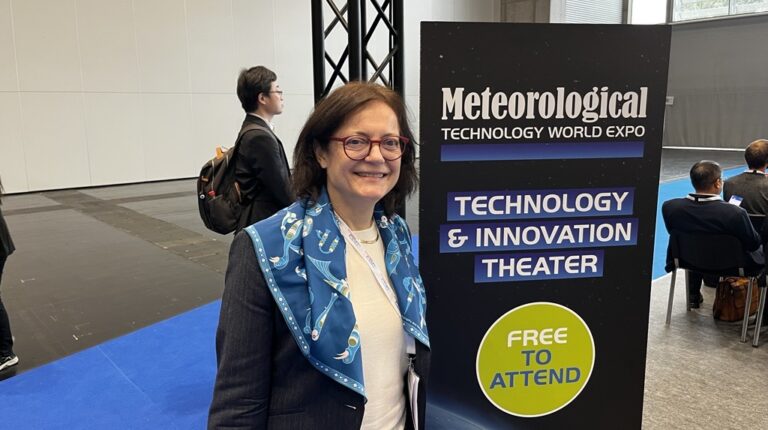
Following her appearance in the ‘Climbing for climate: sustainable monitoring in extreme environments’ panel discussion at Meteorology Technology World Expo 2025, WMO expert Rodica Nitu spoke with Meteorological Technology International about the urgent need to strengthen cryosphere observations. She discussed the technical, governance and communication challenges of monitoring Earth’s coldest regions, and the global collaboration required to preserve these vital climate records for future generations.
You’ve spent many years leading WMO’s work on the cryosphere and polar infrastructure. From your perspective, what are the most urgent priorities for strengthening observations in these regions?
There are three broad priorities: technical, governance and implementation. Technically, we need instruments and systems built for extreme environments – sensors that operate reliably below -40°C, survive extreme winds and run unattended for long periods. In temperate regions one can visit a station every year; in the high mountains, Arctic and Antarctica that’s often impossible. So ruggedness and long-term autonomous life are essential.
Communications are the other big technical piece. Satellite links remain the only reliable way to get data off remote sites, but they’re expensive. Cost-effective solutions for real-time data transmission from remote sites are essential to ensure the availability of data for global models. These might include closer partnerships with satellite providers. And then there’s the accessibility to data and the interoperability of data systems. Much of the cryosphere data is collected and held by research groups at national or regional level. International coordination and standardization are relatively new, and benefits would be delivered from having agreed data representation standards and access protocols that are transferable and cost-effective. The implementation of agreed protocols for cryosphere data at the logger level is one way to broaden the access to research data, whether in real time or in delayed mode, and to generate datasets. The current initiative of WMO on the first mile would eventually be expanded to address the cryosphere data and provide solutions that produce interoperable data at station level.
On governance, in most countries cryosphere-related activities fall under the responsibility of multiple institutions – meteorological services, research institutes, environment ministries – all competing for limited resources. Advocacy is required to show the benefits of collaboration and where cooperation outweighs competition. The access to data between institutions would deliver benefits.
On implementation, the key element is the recognition of local capacities: most countries that have cryosphere outside Western Europe and North America are developing countries, with more limited resources and with emerging research communities. Collaboration with local scientists is vital – not just to build capacity but to share standards and best practices and ensure sustainability.
The cryosphere plays a critical role in the climate system. What emerging technologies or partnerships will have the biggest impact on monitoring and data exchange?
The current technologies and sensors meet many of the measuring requirements, including in extreme environments, such as the polar regions or mountains. I would urge the industry to focus on enhancing the reliability and optimizing the consumption and capacity of power supply in remote and extreme conditions. Secondly, I would strongly advocate for cost-effective real-time data communication.
Getting the meteorological and cryosphere data from polar and high mountains in near real time to processing centers like ECMWF or for monitoring extremes, would make it available for forecasting and warnings. Having cost-effective technical solutions for transmitting the increased amounts of data produced with existing instrumentation, in real time, would be transformational. The WMO Information System (WIS 2.0) includes a few cryosphere variables for real-time data exchange already. Currently, in many cases, data is still logged locally, and technicians are only able to retrieve it during annual or less frequent visits.
From your WMO experience, what were the biggest challenges in coordinating polar and cryosphere data across nations? How can the community overcome them?
Awareness is the most important challenge. Many still assume polar and high-mountain regions are distant from human concerns, but what happens there affects lowland populations worldwide. Furthermore, WMO’s closest community is the national meteorological and hydrological services, while the responsibilities for regions where cryosphere is present often sits outside those services – in polar institutes, research bodies or other government departments. The former are not that well connected to WMO to be actively engaged, so WMO’s reach doesn’t automatically extend to every responsible body.
Overcoming this requires deliberate outreach beyond meteorological services: engaging research institutes, heritage departments, park authorities – whoever holds the relevant mandate locally. Building cross-sectoral agreements, engaging national organizations and showing the local benefits of data sharing helps unlock resources and long-term commitment.
Now that you’re working independently, where do you see the greatest opportunity for innovation and collaboration between research institutions, national services and industry?
Each sector brings pieces of the solution. Research goals drive innovation and offer scientific methods and prototypes; national services bring operational experience and operate networks; industry supplies durable hardware, power and communications. The opportunity is to connect those pieces so a complete, scalable solution can be developed and sustained. I see opportunities in documenting best practices from the innovative research projects for use by other communities.
International collaborative projects like the International Polar Year are useful conveners; they raise awareness and can spark joint projects that link all partners.
Looking ahead, what steps should the international community take to ensure cryospheric data continues to inform climate services, early warnings and policy?
We must think long term about data stewardship. It’s not just about collecting and sharing data today; it’s about preserving it for future generations. The WMO’s precursor, the International Meteorological Organization, recognized at its second Congress in 1871 the need to observe mountains and glaciers and archive these observations. I see it as critical to establish centers with long-term mandates on preserving the data for future generations. Whether it’s by research or meteorological institutions, we need the data to answer questions that may be posed by the future. We need libraries of climate data, like a modern Library of Alexandria for environmental records, including the cryosphere.