


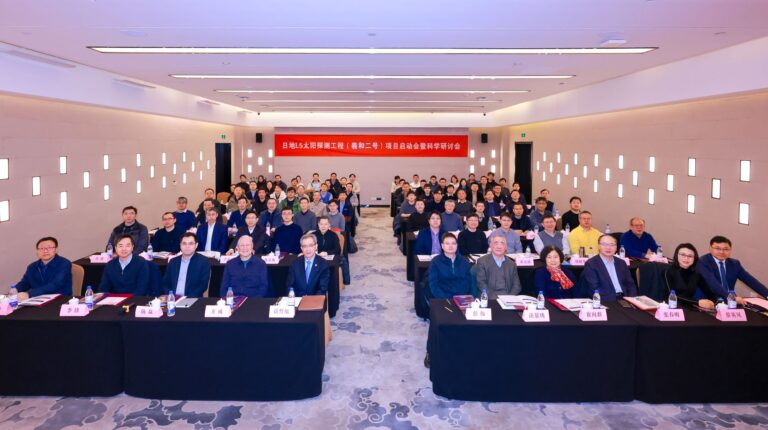
China’s Sun-Earth L5 Solar Exploration Project, known as Xihe-2, has officially entered its implementation phase following a launch meeting and scientific symposium held on January 31, 2026, at Nanjing University (NJU).
The event brought together senior representatives from academia, government and industry, including Tan Zheming, president of NJU and academician of the Chinese Academy of Sciences (CAS), and Zhang Chunming, deputy director of the Shanghai Academy of Spaceflight Technology. Also in attendance were Fang Cheng, CAS academician and professor at NJU’s School of Astronomy and Space Science; Peng Wei, deputy director of the First System Engineering Department of the China National Space Administration (CNSA); and representatives from multiple research institutions involved in the project. The meeting was chaired by Zheng Hairong, executive vice president of NJU and CAS academician.
Speakers highlighted Xihe-2 as a major advancement building on the achievements of China’s first solar exploration satellite, Xihe-1, which was launched in October 2021. According to project leaders, Xihe-2 is a science-driven mission supported by advanced engineering, with a strong emphasis on international relevance and long-term scientific value. NJU and the Shanghai Academy of Spaceflight Technology will jointly lead coordination efforts with participating research units to support project delivery.
Peng Wei outlined the requirements for system engineering development, achievement of scientific objectives and the approach to international cooperation, underscoring the mission’s technical and organizational complexity.
Planned for launch between 2028 and 2029, Xihe-2 is intended to become the world’s first artificial probe deployed at the Sun-Earth L5 Lagrange point. From this position, the spacecraft will conduct long-term, stable observations of the sun, explore previously unobserved regions of the solar system and study the interplanetary space environment. The mission is expected to contribute to research on the mechanisms of solar eruptions and support advances in space weather warning and forecasting capabilities.
During the meeting, professor Li Chuan of NJU presented the scientific background, core research questions and expected outcomes of the mission. You Wei, a researcher at the Shanghai Academy of Spaceflight Technology, introduced the overall spacecraft design and key technical approaches. Discussions among scientists and system designers focused on observation strategies, payload development, data application and data-sharing mechanisms.
In closing remarks, Fang Cheng emphasized the need for close collaboration between scientific, satellite system and payload teams, as well as coordination with other observation platforms, including Sun-Earth L1 missions, near-Earth satellites and ground-based telescopes.
The meeting confirmed Xihe-2’s transition into full implementation, with participating institutions committing to coordinated development and positioning the project as a flagship mission in China’s space science program.
In related news, the sun enters declining phase of solar cycle, but strong space weather still possible, says Met Office