


The WMO has released new guidelines to provide cities with practical tools and methodologies enabling then to generate reliable, comparable information on greenhouse gas emissions.
The Urban Greenhouse Gas Emission Observation and Monitoring Good Research Practice Guidelines, 2025 edition, released by the WMO’s Integrated Global Greenhouse Gas Information System (IG3IS), marks an important step in helping cities to understand and manage their greenhouse gas (GHG) emissions.
The WMO says reliable and consistent GHG information has become essential as the field transitions form research to operational applications with a wide range of stakeholders. By promoting consistency and transparency, the guidelines are designed to improve researcher’s and policymaker’s ability to evaluate emissions data and decision-making.
The guidelines are divided into two parts. The first summarizes the key principles, actions and stakeholder needs, providing an accessible overview for those new to the subject. The second, Extended Technical Discussions, offers in-depth descriptions of 31 techniques for professionals and institutions seeking to apply the methodologies in practice.
According to Jocelyn Turnbull, co-chair of the IG3IS Steering Committee and one of the lead authors of the report, the publication “is the first step on the path to documentary standards, allowing cities and researchers alike to demonstrate that the emissions information they provide is robust and accurate.”
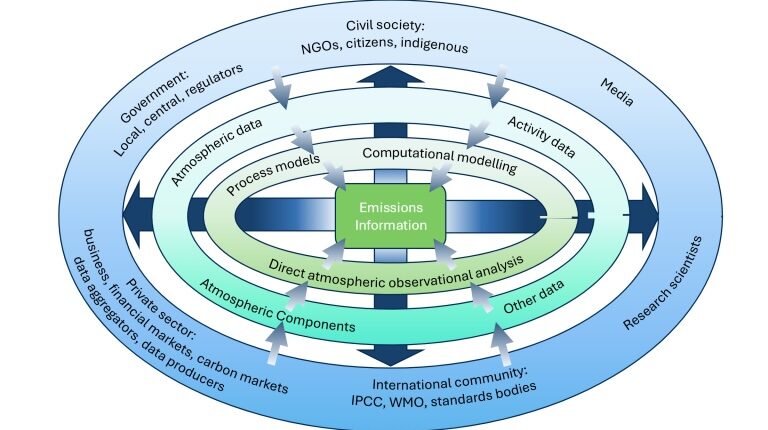
A central principle of the guidelines is that urban GHG information should address stakeholder needs – from tracking emission trends and identifying major sources, to attributing emissions to sectors and understanding spatial and temporal patterns. The document highlights how data from atmospheric observations, activity records and modeling can be integrated to give a fuller picture of emissions and the processes that drive them.
The new guidelines are aimed at a wide audience, including local governments, regulators, private companies, international organizations and researchers. By promoting standardized methods and transparent reporting, the WMO hopes to encourage collaboration across sectors and ensure that data collected in one city can be compared meaningfully with data from another.
Ultimately, the IG3IS Urban Guidelines are intended to help cities take evidence-based action on reducing greenhouse gas emissions – contributing to WMO’s broader mission of supporting science-driven climate solutions.
In related news, WMO Endorses next phase of Global Greenhouse Gas Watch