


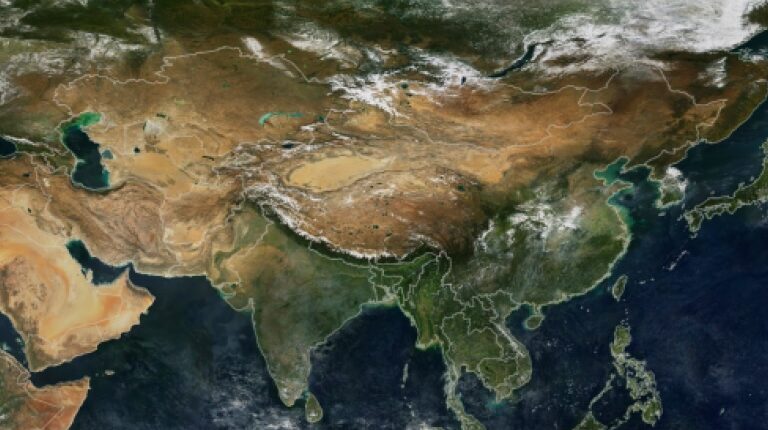
The China Meteorological Administration (CMA) has released the first set of images from its newly launched FY-3H meteorological satellite – a milestone that further strengthens global Earth observation capabilities and enhances China’s contribution to the World Meteorological Organization’s (WMO) Integrated Global Observing System (WIGOS).
The images were captured by the Medium Resolution Spectral Imager-III (MERSI-III) on board FY-3H.
According to the National Satellite Meteorological Centre of the CMA, six of the nine remote sensing instruments on board FY-3H are now active and undergoing in-orbit testing. The first data transmissions demonstrate the satellite’s multi-element atmospheric remote sensing capabilities, including measurements of temperature, humidity and cloud formation, alongside monitoring of greenhouse gases and auroras.
“The FY-3H data will significantly strengthen early warning and climate monitoring capabilities, particularly across the Asia-Oceania region and beyond,” said Natalia Donoho, chief of WMO space systems and utilization. “This highlights the importance of international cooperation and capacity development in satellite meteorology.”
“WMO looks forward to continued collaboration with CMA and partners within the WMO-CGMS framework to ensure that the new Fengyun observations benefit all members, especially developing countries, through open data access and user training,” she added.
The CMA has become increasingly open to global collaboration. In September, the it made its Global Climate Datasets available for international sharing for the first time.
The release of the images from FY-3H coincided with the 15th Asia–Oceania Meteorological Satellite Users Conference (AOMSUC-15) and the 2025 Fengyun International Users Conference, held this week in Qingdao, Shandong. The joint events, hosted by CMA and the China National Space Administration, brought together experts and scholars from over 50 countries to discuss the growing role of satellite technology in global early warning systems and to promote international collaboration in data sharing and innovation.
Zhang Zuqiang, CMA deputy administrator, said he hoped that this conference would serve as an opportunity to actively advance the implementation of the United Nations’ Early Warnings for All initiative, contributing even greater efforts to building resilience.
The FY-3H joins China’s growing fleet of Fengyun-series meteorological satellites, which continue to play a critical role in global weather forecasting, disaster preparedness and climate research. With its advanced payloads and expanded observation scope, FY-3H is set to further integrate China’s meteorological infrastructure into the global satellite observation network, supporting shared goals in climate science and risk mitigation.
In related news, CMA launches first AI-powered meteorological service