


A team of researchers from The University of Oklahoma is developing a unified system that will be capable of issuing short-term warnings of wildfire threats across the US, after receiving a $2,346,892 grant from the National Science Foundation (NSF).
Similar systems exist for weather events such as tornadoes and hurricanes, but warning systems for wildfires currently vary from location to location.
Red-flag warnings are issued a day or two in advance to highlight areas where conditions are ripe for wildfires, but these warnings are relatively large, sometimes the size of a full state or region.
Although the three-year project won’t produce an operational warning system, it will establish the foundational science and stakeholder relationships necessary to eventually implement a unified national approach to wildfire warnings.
“When you think about a warning like a tornado warning, you think about something in a very small spatial area, about the size of a county or a city, and you know that a tornado is likely to come in the next 20 to 30 minutes. We don’t have a nationwide system like that for wildfires right now,” said Joe Ripberger, deputy director for research at the Institute for Public Policy Research and Analysis (IPPRA), and the lead principal researcher on the project.
This is not the first time Ripberger has done research on weather warning systems. He and his colleagues have previously studied warnings for tornadoes, hurricanes and floods, but this will be the first time they have focused specifically on fire.
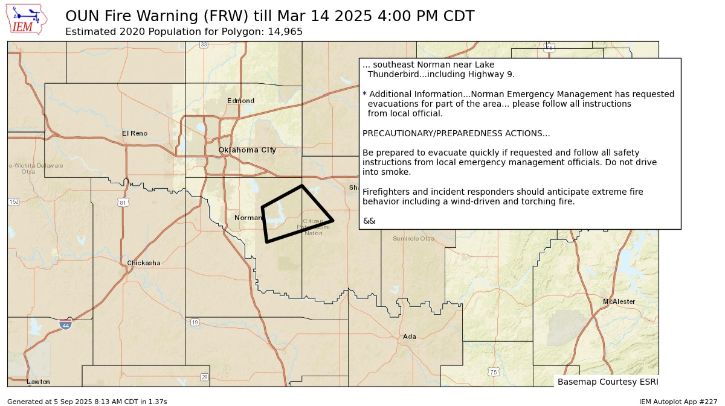
The system’s potential was demonstrated during a major fire event in March of this year, when Oklahoma experienced over 100 fires across the state. Through coordinated efforts between the National Weather Service, state forestry and emergency management agencies, warnings were successfully issued for many of the fires, providing advance notice to populations in their path.
A very high level of coordination was necessary to transmit the information and issue the warnings, especially since focus was spread across the state rather than on one large fire.
Fire and fire weather are different from other types of severe weather threats. A combination of atmospheric and surface conditions governs fires themselves, and surface conditions add another challenge to the warning system.
“You have to consider what the land surface and the fuel on the ground look like in terms of how likely they are to burn, along with what the atmosphere is doing,” commented Ripberger.
Once a fire has developed, it affects the atmosphere. In some cases, fires can even generate their own weather systems, including thunderstorms and tornadoes, creating feedback loops that affect fire behavior and atmospheric conditions.
In addition to the complications presented by fire itself, the necessity of collaboration across entities makes a fire warning system even more challenging. A tornado warning is issued by a single individual at the National Weather Service, while the developing program for fire warnings requires a great deal of communication between various offices.
The project involves 11 senior researchers across four University of Oklahoma entities and the university’s partners IPPRA, the NOAA National Severe Storms Laboratory, the State Climatology Office and the Oklahoma Fire and Mesonet teams.
In related news, a WMO report explores the link between air quality and climate, highlighting the role of aerosols in wildfires