The ‘Climbing for climate: sustainable monitoring in extreme environments’ session at the Meteorological Technology World Expo conference on October 14 brought together experts to discuss ways to strengthen observing systems in some of the world’s harshest environments and expand Project Wayra ahead of the 5th International Polar Year. Chaired by OTT HydroMet’s Jay Pabustan, the panel featured Øystein Godøy (Norwegian Meteorological Institute), Rémy Giraud (WMO/ Météo-France), Rodica Nitu (WMO), Ashish Raval (Synoptic PBC) and Tom Matthews (King’s College London).
Speaking during the session, Godøy emphasized the need to make existing cryospheric data more accessible and reusable. Through initiatives like the WMO’s Global Cryosphere Watch and the GCW Data Publication Service, he and his colleagues are working to lower the barriers for scientists to share and publish FAIR (findable, accessible, interoperable, reusable) datasets. He also highlighted the role of Svalbard as a testbed for satellite calibration and validation, and the ongoing challenge of turning climate observations into actionable information that decision-makers can actually use.
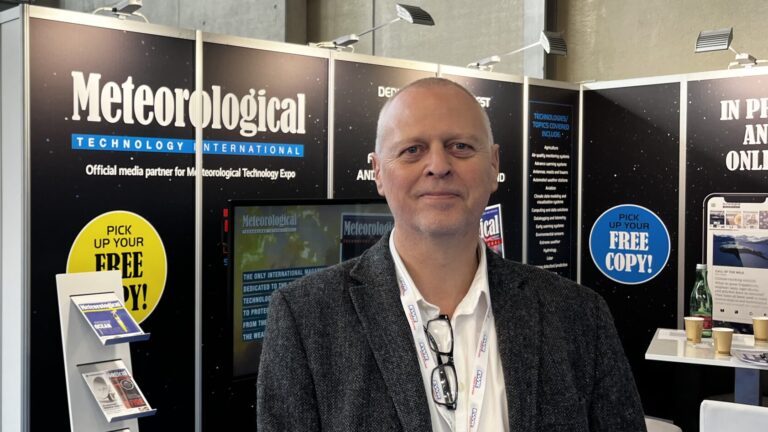
MTI caught up with Godøy at the conference to find out more.
You’ve been involved with the integration of remote sensing, cryosphere monitoring, and data management through roles at MET Norway and WMO initiatives. What is the most pressing gap in current polar and cryosphere observation networks that needs urgent attention?
There is so much data out there that is not managed properly and is not available for reuse. I would say the most pressing issue right now is getting all existing data into a form where it can be shared and reused.
What’s the best way to address that gap?
Through the WMO Global Cryosphere Watch we have, for years, worked with national meteorological and hydrological services and scientific/research-oriented data centers. The challenge is the threshold for people to actually submit their data. To address that, we developed what we call the GCW Data Publication Service, which helps people publish their data in a much easier, more cost-efficient manner. We have a setup with our colleagues at WSL/SLF in Switzerland where a scientist can submit their data, have it quality controlled and receive back a FAIR-compliant dataset.
What have been the major challenges in making cryospheric data truly FAIR, and how can the community push forward?
I think the technologies needed have existed for a long time. The main challenge is at the human level: getting people to understand the benefit of sharing data, and persuading funding agencies of that benefit too. That’s why we set up the GCW Data Publication Service to help scientists publish their data more cost-efficiently. We’ve also identified that technological competence among some observers and monitors can be limited; if we can simplify the process for them, it will be hugely beneficial.
The Svalbard Integrated Arctic Earth Observing System (SIOS) is a key infrastructure you engage with. How do you see its role evolving – and how will it connect with global frameworks like WIS 2.0?
SIOS is a key infrastructure in the European Arctic. It is a cost-efficient way to monitor the Arctic because there is easy access, frequent flight connections, good infrastructure and the possibility to test equipment in quite harsh conditions. We already maintain through SIOS a distributed data management system where many infrastructure owners share their data, and the same infrastructure owners collaborate to optimize the observation system on Svalbard and in the surrounding oceanic and atmospheric areas. I expect SIOS to be a core component of data management during the next International Polar Year because it is already network-oriented in its approach.
There are a lot of lessons learned in SIOS about distributed, network-oriented data management and the coordination of efforts. The link to WIS 2.0 is a bit further down the line. I think there will be a focus on developing Svalbard as a calibration and validation site for remote sensing data and numerical modeling. I also expect efforts to use Svalbard for future cal/val activities related to, for example, ESA missions. Some of the data is already within the WIS system through the Norwegian Meteorological Institute, and other data is a candidate to be incorporated into that framework.
Are there emerging sensor technologies or novel platforms that could revolutionize cryosphere monitoring?
I’m hesitant to use the word ‘revolutionize,’ but I do think there are opportunities now. I’m looking forward to ROSE-L and CIMR – those are important platforms for the Arctic. There are also the Arctic Weather Satellite and systems of small satellites that are promising.
Although remote sensing gives good spatial coverage, to efficiently use satellite products you need in situ information to calibrate to ground truth. That is challenging in the high Arctic and other remote places, because gathering ground truth is difficult and costly. This is where Svalbard can play a role: you can test in surrounding areas of Svalbard before entering the interior Arctic Ocean, where calibration/validation activities are much more costly.
Svalbard is an area where we have a lot of collaboration on drone technology, although not necessarily for monitoring – more for process studies. For the time being, drone endurance is insufficient for broad monitoring capabilities. A combination of aircraft and satellites for monitoring, and drones for process-oriented studies and local detail, is probably the way forward.
Given the accelerating climate changes in polar regions, how can forecasting, modeling and observation systems better feed into decision-making (e.g. for climate policy, adaptation, risk management)?
For day-to-day operations you need real-time information; for many management activities, delayed climate-consistent information is usually sufficient. Numerical modeling – and even machine learning in the future – can be used for predictions and for analyzing the current state. We need both real-time and delayed mode observations to understand how conditions are today, how they were in the past and how they might look in the future.
For example, we have combined satellite-based sea-ice monitoring with climate scenarios from climate models. More specifically, we combined EUMETSAT ocean and sea ice SAF climate-consistent products from satellite data with climate scenarios from several climate models under the IPCC CMIP activity. Products like this put things in perspective when looking things such as emission scenarios.
If model predictions don’t fit the past, they are unlikely to be reliable for the future. How this affects local communities and management at different levels is a very difficult question. Often, we do not provide the information decision-makers actually need: we tend to think in our own box about what they require, but perhaps they need something else – and certainly a higher-level product than what we currently deliver. In a project we are now finishing, named Arctic PASSION, funded by the EU, we have looked at what is needed at local, regional, national and European levels for policy decision-making. We can improve a lot in this area: we need to understand how people actually use the information we provide and translate it into something useful, rather than just providing what we think they need.
Meteorological Technology World Expo continues in Vienna on October 15 and 16. Click here to register for your free pass