


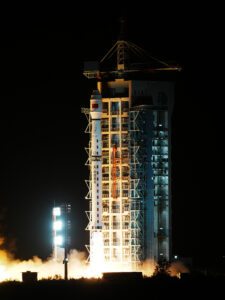
China successfully launched the Fengyun-3H meteorological satellite (FY-3H) using a Long March 4C carrier rocket at the Jiuquan Satellite Launch Center in Gansu on September 27.
The satellite is a new member of the FY polar-orbiting meteorological ‘afternoon satellite’ family, with a payload configuration and performance indicators that are said to be on a par with the most sophisticated technologies in the world, according to the CMA.
It will take over the in-orbit operations of the FY-3D, which has been in service for nearly eight years.
It is predicted that the FY-3H will expand the data acquisition capability for multiple spheres of the Earth system and further enhance global service quality, while guaranteeing its core operations of global imaging and atmospheric vertical sounding.
Dr Cao Xiaozhong, chief commander of the FY Meteorological Satellite Project and deputy administrator of the China Meteorological Administration (CMA), stated that in recent years, China has continuously enhanced the influence of its FY meteorological satellites, becoming a role model for serving global sustainable development.
The F3-3H will join the FY-3F, FY-3E and FY-3G in China’s ‘afternoon satellite’ network. Wang Jinson, director general of the National Satellite Meteorological Centre (National Space Weather Monitoring and Warning Centre) of CMA and chief designer of the FY Meteorological Satellite Project, stated that this network can deliver observational data that is globally distributed across space, time and different scales.
Payload and capabilities
The new satellite is equipped with nine effective payloads which include a newly developed Greenhouse-gases Absorption Spectrometer II (GAS-II), an upgraded Wide-field Auroral Imager-II (WAI-II), as well as seven inherited payloads such as the Medium Resolution Spectral Imager-III (MERSI-III) and Hyperspectral Infrared Atmospheric Sounder-II (HIRAS-II).
According to the CMA, the GAS-II is the first in the world to achieve global greenhouse gas monitoring with a 100km swath width. Through refined sounding of atmospheric absorption lines across four spectral bands from near-infrared to shortwave infrared, it can obtain column concentration data of major greenhouse gases in the atmosphere, enabling precise global greenhouse gas detection and support global climate change monitoring.
The WAI-II is said to be capable of wide-field auroral imaging and sounding of the concentration of precipitating particles. With a spectral coverage of 140nm to 180nm, it can provide real-time forecasts of aurora intensity and extent, as well as current reports on precipitating particles in polar regions, enabling forecasts of magnetic storms, magnetospheric substorms and polar ionospheric weather.
The FY-3H will deliver 70 products across six major categories of cloud radiation, sea surface, land surface, atmospheric parameters, atmospheric composition and space weather.
The CMA says these products will support core meteorological operations, cater to the needs of space weather forecasting and support services, and enhance China’s capabilities in global numerical weather prediction (NWP), global climate change monitoring, ecological environment monitoring and disaster prevention and mitigation.
In related news, NASA and the NOAA launched a space weather mission on September 24 to investigate the sun’s influence across the solar system