


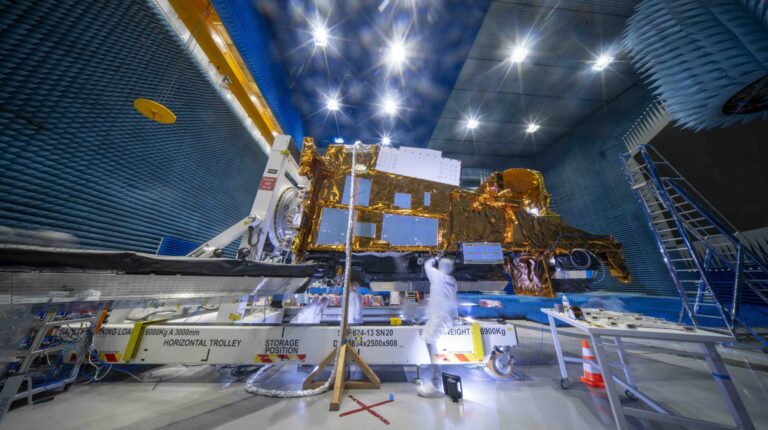
The MetOP Second Generation-B1 satellite, developed by the European Space Agency (ESA) and EUMETSAT, has entered its third round of pre-launch testing, marking another step toward strengthening Europe’s weather forecasting capability. It is the second satellite in a series of six, and will join MetOp-SG-A1, which was launched on August 13 from French Guiana.
Engineers are putting the satellite through rigorous electromagnetic compatibility tests to ensure its electronic systems can operate without interfering with one another once the new weather satellite is in orbit around Earth next year, when it will partner with MetOp-SG-A1. The two are equipped with a complementary suite of instruments – 11 between them – to provide high resolution measurements of temperature, precipitation, clouds, winds and other key atmospheric and environmental variables.
Referred to by the ESA as “one of the most advanced atmospheric monitoring systems ever deployed”, the MetOp-SG mission, comprising three successive pairs of satellites, will supply meteorologists with the global data essential for predicting storms, tracking climate trends and improving the accuracy of everyday weather forecasts for more than two decades.
The MetOp-SG B-type satellites carry five instruments: a scatterometer, to provide ocean-surface wind vectors and land-surface soil moisture; a radio occultation sounder (which is also on the A-type satellites) to provide atmospheric temperature and humidity profiles as well as information about the ionosphere; a microwave imager to monitor precipitation and to assess sea-ice extent; an ice cloud imager to measure cloud-ice water; and an Argos-4 advanced data collection system, which gathers and transmits data from surface, buoy, ship, balloon and airborne platforms.
The satellite also carries a typical array of onboard computers, power systems and high-rate transmitters operating in S-, X- and Ka-bands to stream down the massive volumes of data the satellite collects.
Engineers have placed MetOp-SG-B1 inside a fully shielded anechoic chamber in Toulouse, France, to carry out exhaustive electromagnetic compatibility checks, ensuring all onboard systems can operate without interfering with one another.
The campaign includes launcher-compatibility tests, receiver-margin measurements and full-power auto-compatibility trials to confirm that the satellite’s instruments remain stable and sensitive in a harsh electromagnetic environment.
Spanning several weeks, the process blends advanced analysis with practical troubleshooting, marking the final major environmental hurdle before the satellite’s planned 2026 launch.
In related news, Sentinel-6B launches to advance global sea-level record