


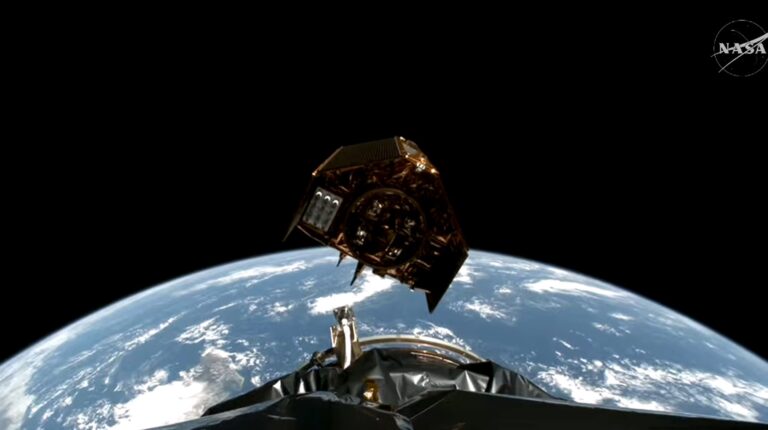
The Sentinel-6B satellite launched on November 17 at 06:21 CET on a SpaceX Falcon 9 rocket from Vandenberg Space Force Base in California. The spacecraft was delivered into orbit just under an hour after liftoff, and at 07:54 CET ESA’s European Space Operations Centre (ESOC) in Germany received the first signal via the Inuvik ground station in Canada, confirming that Sentinel-6B is functioning well.
Sentinel-6B will continue the mission of Sentinel-6 Michael Freilich, launched in November 2020. The Copernicus Sentinel-6 mission is the world’s primary reference for satellite sea-surface height measurements, extending a continuous data record that began in the early 1990s with the French-US Topex-Poseidon mission and continued with the Jason satellite series.
Given the importance of sea-level rise on the global climate agenda, international partners have worked to establish Copernicus Sentinel-6 as the gold-standard reference mission, delivering more precise sea-surface height data than any previous system.
Although part of the European Union’s Copernicus program, Sentinel-6 is a product of broad international cooperation involving the European Commission, ESA, NASA, Eumetsat and NOAA, with additional support from the French space agency CNES.
ESA’s director of earth observation programmes, Simonetta Cheli, said, “Collaboration between partners is key to a mission such as Sentinel-6, and my thanks go to everyone involved in developing, launching and operating this exceptional satellite, which follows in the footsteps of the first Sentinel-6, Michael Freilich. This achievement demonstrates what can be accomplished when international agencies and industries work together toward a shared goal. Sentinel-6B will ensure that we continue to collect the high-precision data needed to understand our changing climate, safeguard our oceans and support decisions that protect coastal communities around the world.”
In addition to tracking long-term sea-level change, the mission provides significant wave height and wind speed data for real-time ocean forecasting. Satellite altimetry remains the most comprehensive source of global ocean sea-state measurements.
Sentinel-6 satellites use a radar altimeter that measures the time it takes for radar pulses to return from the ocean surface, combined with precise orbit data, to calculate sea-surface height. An advanced microwave radiometer from NASA corrects for the effect of atmospheric water vapour, improving measurement accuracy.
Sentinel-6B is now undergoing its Launch and Early Orbit Phase under ESA control. Once complete, operations will transfer to Eumetsat.
In related news, CMA releases first FY-3H satellite images