


Close Menu
Meteorological Technology International
  • News
    • A-E
      • Agriculture
      • Automated Weather Stations
      • Aviation
      • Climate Measurement
      • Data
      • Developing Countries
      • Digital Applications
      • Early Warning Systems
      • Extreme Weather
    • G-P
      • Hydrology
      • Lidar
      • Lightning Detection
      • New Appointments
      • Nowcasting
      • Numerical Weather Prediction
      • Polar Weather
    • R-S
      • Radar
      • Rainfall
      • Remote Sensing
      • Renewable Energy
      • Satellites
      • Solar
      • Space Weather
      • Supercomputers
    • T-Z
      • Training
      • Transport
      • Weather Instruments
      • Wind
      • World Meteorological Organization
      • Meteorological Technology World Expo
  • Features
  • Online Magazines
    • January 2026
    • April 2025
    • January 2025
    • September 2024
    • April 2024
    • Archive Issues
    • Subscribe Free!
  • Opinion
  • Videos
  • Supplier Spotlight
  • Expo
LinkedIn X (Twitter) Facebook
  • Sign-up for Free Weekly E-Newsletter
  • Meet the Editors
  • Contact Us
  • Media Pack
LinkedIn Facebook
Subscribe
Meteorological Technology International
  • News
      • Agriculture
      • Automated Weather Stations
      • Aviation
      • Climate Measurement
      • Data
      • Developing Countries
      • Digital Applications
      • Early Warning Systems
      • Extreme Weather
      • Hydrology
      • Lidar
      • Lightning Detection
      • New Appointments
      • Nowcasting
      • Numerical Weather Prediction
      • Polar Weather
      • Radar
      • Rainfall
      • Remote Sensing
      • Renewable Energy
      • Satellites
      • Solar
      • Space Weather
      • Supercomputers
      • Training
      • Transport
      • Weather Instruments
      • Wind
      • World Meteorological Organization
      • Meteorological Technology World Expo
  • Features
  • Online Magazines
    1. January 2026
    2. September 2025
    3. April 2025
    4. January 2025
    5. September 2024
    6. April 2024
    7. January 2024
    8. September 2023
    9. April 2023
    10. Archive Issues
    11. Subscribe Free!
    Featured
    November 27, 2025

    In this Issue – January 2026

    By Hazel KingNovember 27, 2025
    Recent

    In this Issue – January 2026

    November 27, 2025

    In this Issue – September 2025

    August 11, 2025

    In this Issue – April 2025

    April 15, 2025
  • Opinion
  • Videos
  • Supplier Spotlight
  • Expo
Facebook LinkedIn
Subscribe
Meteorological Technology International
Satellites

US Space Force launches electro-optical/infrared weather systems cubesat mission

Dan SymondsBy Dan SymondsJanuary 6, 20232 Mins Read
Share LinkedIn Facebook Twitter Email
Share
LinkedIn Facebook Twitter Email

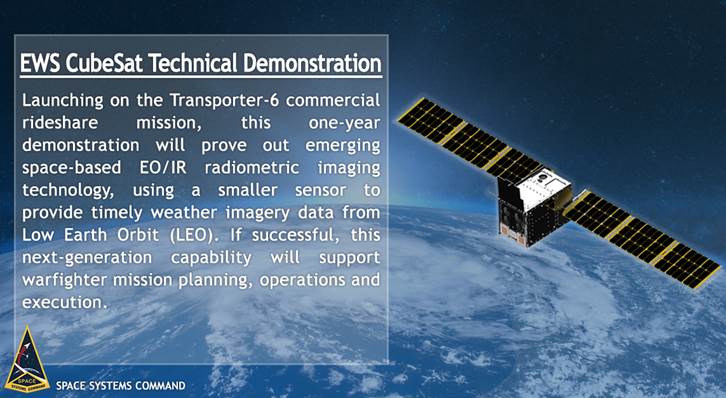
Space Systems Command (SSC), the US Space Force’s space development, acquisition, launch and logistics field command, has successfully launched its electro-optical/infrared weather systems (EWS) cubesat technical demonstration on board the SpaceX Transporter-6 mission from Cape Canaveral Space Force Station, Florida.

Launched on January 3, 2022, the one-year demonstration will validate emerging space-based EO/IR radiometric imaging technology, using a smaller sensor to provide timely weather imagery data from low Earth orbit (LEO).

Lt. Col. Joe Maguadog, EWS materiel leader and program manager, said, “The EWS cubesat technical demonstration effort represents SSC’s continued commitment to working with non-traditional partners to broaden the competitive industrial base. If successful, this will provide an innovative option to deliver space-based environmental monitoring data to the warfighter at an operationally relevant speed. This demonstration will inform our transition toward a more affordable, scalable and resilient EO/IR weather constellation.”

In February 2022, the EWS program competitively selected two vendors to develop and launch two separate sensor prototypes. Orion Space Solutions, a non-traditional government contractor, delivered the cubesat for the demonstration.

General Atomics Electromagnetic Systems Group will deliver the second prototype by 2025. This launch satisfies the FY20 National Defense Authorization Act (NDAA) Congressional mandate to launch a weather EO/IR pathfinder prototype by FY23. The program expects the first transmittal of data early in 2023.

Previous ArticleDavis Instruments unveils WeatherLink Console at CES 2023
Next Article Climate change drives UK’s first year over 10°C, reports Met Office

Read Similar Stories

Space Weather

Northumbria University secures £4m to study Earth’s radiation belts

April 16, 20262 Mins Read
Extreme Weather

AI model improves real-time prediction of wildfire spread

April 16, 20263 Mins Read
Satellites

AI tool uses weather satellite data to map ocean currents in near real time

April 14, 20263 Mins Read
Latest News

ForecastWatch expands with launch of new independent platform for weather forecast verification

April 28, 2026

European climate report highlights record heat, glacier loss and rising extremes

April 27, 2026

WMO signals increasing likelihood of El Niño developing in 2026

April 24, 2026

Receive breaking stories and features in your inbox each week, for free


Enter your email address:


Supplier Spotlights
  • Reuniwatt
Getting in Touch
  • Contact Us / Advertise
  • Meet the Editors
  • Media Pack
  • Free Weekly E-Newsletter
Our Social Channels
  • Facebook
  • LinkedIn
© 2026 UKi Media & Events a division of UKIP Media & Events Ltd
  • Cookie Policy
  • Privacy Policy
  • Terms and Conditions
  • Notice and Takedown Policy

Type above and press Enter to search. Press Esc to cancel.