


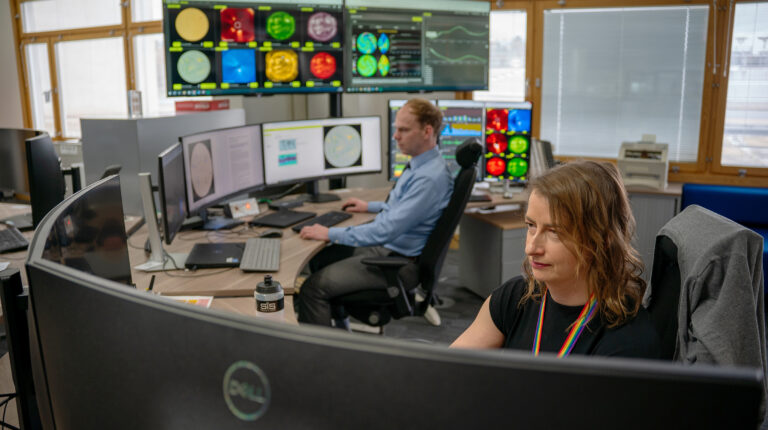
The UK Met Office has unveiled a “pioneering” space weather forecasting system that, for the first time, enables operational modeling of the Earth’s upper atmosphere – marking what the organization describes as a “major breakthrough” for UK atmospheric science.
Developed under the UKRI-funded Space Weather Instrumentation, Measurement, Modelling and Risk (SWIMMR) program, the new Advanced Ensemble Networked Assimilation System (AENAS) provides real-time forecasts of how space weather affects the ionosphere and thermosphere.
Built at the University of Birmingham in collaboration with Lancaster, Leeds, Bath and Leicester universities and the British Antarctic Survey, the system is now running on the Met Office’s new supercomputer.
Complementing existing solar forecasting models, AENAS enhances the UK’s ability to predict space weather impacts on satellites, aviation, communications and GNSS-dependent services. The suite also includes ODRAM, a Lancaster University model that specializes in forecasting disruptions to high-frequency radio communications used on polar flight routes.
Met Office space weather manager Simon Machin said, “This delivers a world-leading capability that provides greater confidence and forecasting skill than any models currently in operation anywhere else in the world.
“This isn’t just about science – it’s about protecting the systems we rely on every day. From aircraft communications to GPS in your phone, space weather can affect us all.”
Science minister Sir Patrick Vallance said, “Once again, cutting-edge British innovation is making a remarkable difference to our daily lives – this time from way up in the atmosphere.
“This is a really exciting example of how better understanding of what’s happening in space can protect the tech we all rely on, from GPS on our phones to keeping the power grid working.”
The new capability integrates near real-time data on the ionosphere and thermosphere with solar activity forecasts, providing more accurate and actionable upper atmosphere forecasts – strengthening the UK’s resilience to space weather disruptions.
In related news, the Met Office has contributed to research suggesting that Europe could face fewer but more devastating hailstorms