


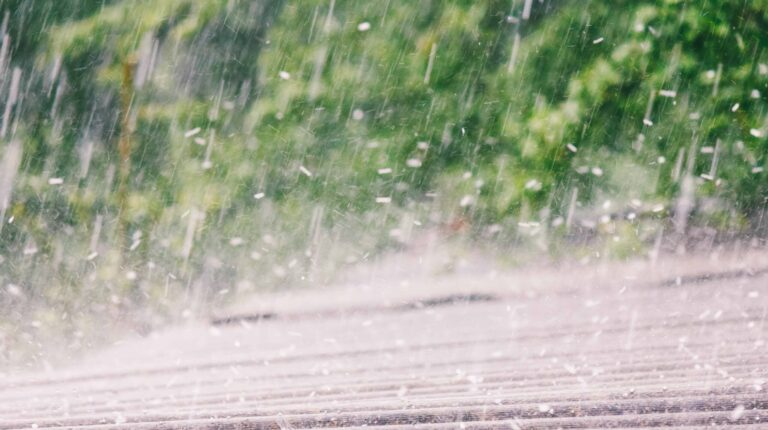
New research suggests that Europe could face fewer hailstorms in future, but the ones that do occur may be far more destructive.
A team from the UK Met Office, Newcastle University and the University of Bristol used Europe-wide kilometer-scale climate simulations to assess how global warming could affect hail. The study, published in the journal Nature Communications, found that under a high-emissions scenario (RCP8.5), severe hail is likely to become less common, except potentially for very large hail.
Severe hail has a diameter of 2cm, while a diameter of 5cm or more is considered very large. Bigger hailstones cause more damage than smaller ones, and even a small increase in their size could outweigh any benefits from having fewer hailstorms overall.
Study lead author, Dr Abdullah Kahraman, visiting scientist, climate processes and projections (CPP), Met Office Hadley Centre and senior researcher in severe weather and climate change, Newcastle University, said, “Our findings indicate that the effects of climate change on severe thunderstorms are more complex than previously thought, and high-resolution models can produce results that differ significantly from earlier research. Society may need to prepare for less frequent, yet more damaging hail events locally, in a 5° warmer future.”
Researchers link the overall decline in hail to weaker storm updrafts, increased melting higher in the atmosphere and weaker large-scale circulation. But they also highlight a shift toward tropical-type thunderstorms in warmer conditions – capable of producing giant hailstones that still reach the surface.
These storms are expected to be most frequent over southern Europe, with autumn and winter bringing the highest risk. Central and Northern Europe, especially the UK, are projected to see fewer very large hail events.
“These results are very concerning,” said professor Lizzie Kendon of the UK Met Office. “We need to be prepared for tropical-type hailstorms in Europe, associated with very large hailstones that can cause severe impacts.”
The authors acknowledge the uncertainty regarding the effect of enhanced melting associated with higher freezing levels on the largest hailstones. They recommend further studies of these warm thunderstorms to improve the understanding of their potential to produce very large and damaging hail at the surface.
In related news, a WMO report finds that the water cycle is becomingly increasingly erratic