


Close Menu
Meteorological Technology International
  • News
    • A-E
      • Agriculture
      • Automated Weather Stations
      • Aviation
      • Climate Measurement
      • Data
      • Developing Countries
      • Digital Applications
      • Early Warning Systems
      • Extreme Weather
    • G-P
      • Hydrology
      • Lidar
      • Lightning Detection
      • New Appointments
      • Nowcasting
      • Numerical Weather Prediction
      • Polar Weather
    • R-S
      • Radar
      • Rainfall
      • Remote Sensing
      • Renewable Energy
      • Satellites
      • Solar
      • Space Weather
      • Supercomputers
    • T-Z
      • Training
      • Transport
      • Weather Instruments
      • Wind
      • World Meteorological Organization
      • Meteorological Technology World Expo
  • Features
  • Online Magazines
    • January 2026
    • April 2025
    • January 2025
    • September 2024
    • April 2024
    • Archive Issues
    • Subscribe Free!
  • Opinion
  • Videos
  • Supplier Spotlight
  • Expo
LinkedIn X (Twitter) Facebook
  • Sign-up for Free Weekly E-Newsletter
  • Meet the Editors
  • Contact Us
  • Media Pack
LinkedIn Facebook
Subscribe
Meteorological Technology International
  • News
      • Agriculture
      • Automated Weather Stations
      • Aviation
      • Climate Measurement
      • Data
      • Developing Countries
      • Digital Applications
      • Early Warning Systems
      • Extreme Weather
      • Hydrology
      • Lidar
      • Lightning Detection
      • New Appointments
      • Nowcasting
      • Numerical Weather Prediction
      • Polar Weather
      • Radar
      • Rainfall
      • Remote Sensing
      • Renewable Energy
      • Satellites
      • Solar
      • Space Weather
      • Supercomputers
      • Training
      • Transport
      • Weather Instruments
      • Wind
      • World Meteorological Organization
      • Meteorological Technology World Expo
  • Features
  • Online Magazines
    1. January 2026
    2. September 2025
    3. April 2025
    4. January 2025
    5. September 2024
    6. April 2024
    7. January 2024
    8. September 2023
    9. April 2023
    10. Archive Issues
    11. Subscribe Free!
    Featured
    November 27, 2025

    In this Issue – January 2026

    By Hazel KingNovember 27, 2025
    Recent

    In this Issue – January 2026

    November 27, 2025

    In this Issue – September 2025

    August 11, 2025

    In this Issue – April 2025

    April 15, 2025
  • Opinion
  • Videos
  • Supplier Spotlight
  • Expo
Facebook LinkedIn
Subscribe
Meteorological Technology International
Aviation

UAE launches UAV campaign to enhance rainfall

Helen NormanBy Helen NormanMarch 9, 20212 Mins Read
Share LinkedIn Facebook Twitter Email
UAE UAV
Share
LinkedIn Facebook Twitter Email

As part of the UAE Research Program for Rain Enhancement Science (UAEREP), the country’s National Center of Meteorology (NCM) has launched a campaign to evaluate the effectiveness of electric charge emission technology in modifying the behavior of cloud droplets. The aim of the campaign is to enhance the rainfall process.

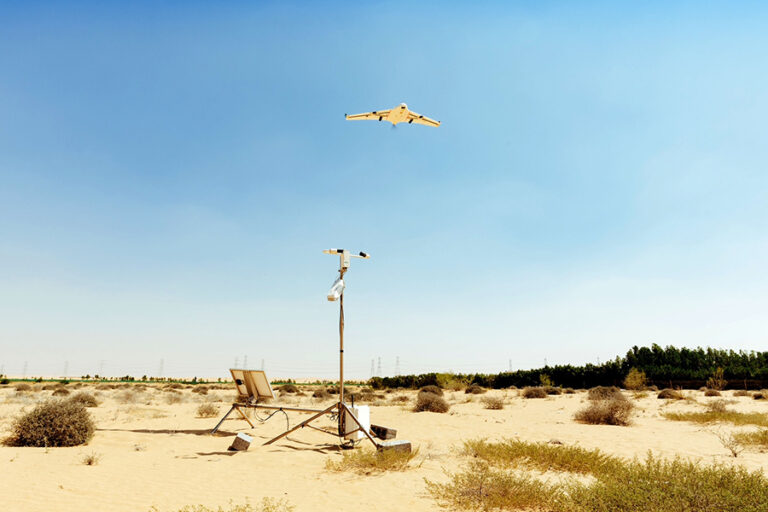
Taking place at the SANAD Academy, the UAE’s remotely piloted aircraft training and certification academy, the campaign uses unmanned aerial vehicles (UAVs) equipped with a payload of electric charge emission instruments and customized sensors.

Charge emission technology can enable the use of a small and lightweight platform to deliver a charge into the clouds instead of traditional cloud seeding payloads, which require much larger aircraft. This method does not involve the emission of any solid particles into clouds, such as silver iodide or salt.

Developed and tested in the UK and Finland, the effectiveness of the payload for charge emission and electrification is tested on clear air days in the UAE and then, once conditions permit, in light fog events as the presence of dust particles in the UAE atmosphere is expected to lead to more highly charged conditions. The UAVs fly at low altitudes around a meteorological mast instrumented with an electric field mill. Charge is emitted by the UAV and detected at the surface by the electric field mill.

Led by Giles Harrison, professor of atmospheric physics at the UK’s University of Reading, the campaign is conducted with the support of experts from NCM, UAEREP and several local and international research and academic organizations including the University of Bath.

Professor Giles Harrison, said, “Our project aims to evaluate the importance of charge in affecting the cloud droplet size distribution and rainfall generation through modifying the behavior of droplets and particles and studying the microphysical and electric properties of fog events. We are using UAVs in our test campaigns as they provide a cost-effective and flexible method of delivering charge to cloud layer altitudes.”

Previous ArticleHow NPL’s STAR facility will support climate monitoring from space
Next Article Thales to support Meteomatics to develop hyperlocal forecasts using drones

Read Similar Stories

Climate Measurement

Study identifies atmospheric trigger behind flash droughts in Puerto Rico

April 15, 20263 Mins Read
Aviation

Met Office launches platform to support needs of evolving aviation industry

March 24, 20262 Mins Read
Rainfall

New research to improve flash flood warnings in rural Virginia

March 17, 20263 Mins Read
Latest News

ForecastWatch expands with launch of new independent platform for weather forecast verification

April 28, 2026

European climate report highlights record heat, glacier loss and rising extremes

April 27, 2026

WMO signals increasing likelihood of El Niño developing in 2026

April 24, 2026

Receive breaking stories and features in your inbox each week, for free


Enter your email address:


Supplier Spotlights
  • Adolf Thies GmbH & Co. KG
Getting in Touch
  • Contact Us / Advertise
  • Meet the Editors
  • Media Pack
  • Free Weekly E-Newsletter
Our Social Channels
  • Facebook
  • LinkedIn
© 2026 UKi Media & Events a division of UKIP Media & Events Ltd
  • Cookie Policy
  • Privacy Policy
  • Terms and Conditions
  • Notice and Takedown Policy

Type above and press Enter to search. Press Esc to cancel.