


Close Menu
Meteorological Technology International
  • News
    • A-E
      • Agriculture
      • Automated Weather Stations
      • Aviation
      • Climate Measurement
      • Data
      • Developing Countries
      • Digital Applications
      • Early Warning Systems
      • Extreme Weather
    • G-P
      • Hydrology
      • Lidar
      • Lightning Detection
      • New Appointments
      • Nowcasting
      • Numerical Weather Prediction
      • Polar Weather
    • R-S
      • Radar
      • Rainfall
      • Remote Sensing
      • Renewable Energy
      • Satellites
      • Solar
      • Space Weather
      • Supercomputers
    • T-Z
      • Training
      • Transport
      • Weather Instruments
      • Wind
      • World Meteorological Organization
      • Meteorological Technology World Expo
  • Features
  • Online Magazines
    • January 2026
    • April 2025
    • January 2025
    • September 2024
    • April 2024
    • Archive Issues
    • Subscribe Free!
  • Opinion
  • Videos
  • Supplier Spotlight
  • Expo
LinkedIn X (Twitter) Facebook
  • Sign-up for Free Weekly E-Newsletter
  • Meet the Editors
  • Contact Us
  • Media Pack
LinkedIn Facebook
Subscribe
Meteorological Technology International
  • News
      • Agriculture
      • Automated Weather Stations
      • Aviation
      • Climate Measurement
      • Data
      • Developing Countries
      • Digital Applications
      • Early Warning Systems
      • Extreme Weather
      • Hydrology
      • Lidar
      • Lightning Detection
      • New Appointments
      • Nowcasting
      • Numerical Weather Prediction
      • Polar Weather
      • Radar
      • Rainfall
      • Remote Sensing
      • Renewable Energy
      • Satellites
      • Solar
      • Space Weather
      • Supercomputers
      • Training
      • Transport
      • Weather Instruments
      • Wind
      • World Meteorological Organization
      • Meteorological Technology World Expo
  • Features
  • Online Magazines
    1. April 2026
    2. January 2026
    3. September 2025
    4. April 2025
    5. January 2025
    6. September 2024
    7. April 2024
    8. January 2024
    9. Archive Issues
    10. Subscribe Free!
    Featured
    May 5, 2026

    In this Issue – April 2026

    By Web TeamMay 5, 2026
    Recent

    In this Issue – April 2026

    May 5, 2026

    In this Issue – January 2026

    November 27, 2025

    In this Issue – September 2025

    August 11, 2025
  • Opinion
  • Videos
  • Supplier Spotlight
  • Expo
Facebook LinkedIn
Subscribe
Meteorological Technology International
Extreme Weather

NOAA unveils participants for 2023 Urban Heat Island mapping campaign

Dan SymondsBy Dan SymondsApril 6, 20233 Mins Read
Share LinkedIn Facebook Twitter Email
Share
LinkedIn Facebook Twitter Email

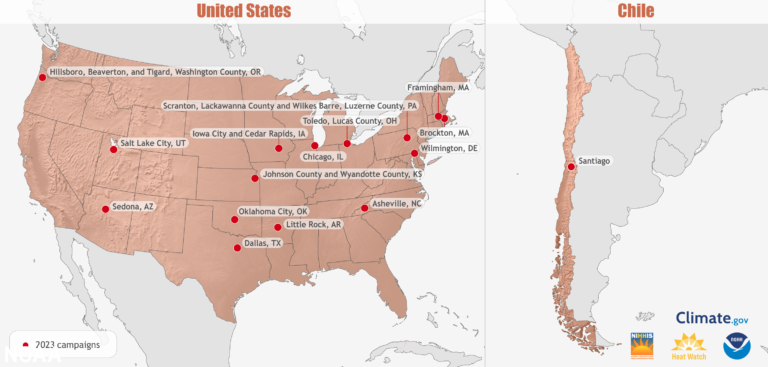
NOAA’s Urban Heat Island (UHI) mapping campaign will take place in 18 communities across 14 states and in one international city this summer.

Now in its seventh year, the UHI mapping campaign helps local decision-makers take actions to reduce the health impacts of extreme heat, which often target the most vulnerable.

Rick Spinrad, NOAA Administrator, said, “The burden of heat is not shared equally in our urban areas. Gathering this type of environmental intelligence helps communities measure their hottest places so they can develop strategies to reduce the dangerous effects of heat. Community by community, we’re working to create a Climate-Ready Nation that is resilient in a changing world.”

Communities chosen for the 2023 program are: Chicago; Salt Lake City; Dallas; Oklahoma City; Asheville, North Carolina; Framingham and Brockton, Massachusetts; Johnson County and Wyandotte County, Kansas, which includes the Kansas City suburbs; Wilmington, Delaware; Toledo, Ohio; Little Rock, Arkansas; Scranton and Wilkes-Barre, Pennsylvania; Sedona, Arizona; Iowa City and Cedar Rapids, Iowa; and Washington County, Oregon, outside of Portland.

In addition, NOAA is working with local groups and the Pan-American Health Organization on an international heat island mapping campaign in Santiago, Chile. This will be the third NOAA-funded international campaign. Campaigns were completed in Freetown, Sierra Leone and Rio de Janeiro, Brazil earlier this year.

Since 2017, NOAA, through the interagency National Integrated Heat Health Information System (NIHHIS), has funded CAPA Strategies to provide science support for more than 70 community-led urban heat island mapping campaigns. Led by a team of local partners in each city, volunteer citizen scientists will travel through their neighborhoods in the morning, afternoon and evening on one of the hottest days of the year with heat sensors mounted on their own cars or bikes. The sensors record temperature, humidity, time and the volunteers’ location every second. CAPA’s end-to-end program, including sensor technology, analysis, modeling and community engagement, allows communities to develop hyper-local descriptions of heat and strategize mitigation options specific to each community and its needs.

During the 2022 urban heat island campaigns, 782 citizen scientists collected over one million measurements in 15 US communities.

Cities from past campaigns have used their heat island maps to implement tree planting strategies, inform communities of the location of new public transit shelters for cooling relief, develop heat action plans, educate residents and policymakers and inform new research. The data from the UHI campaigns are open access and available on the federal website Heat.gov.

Previous ArticleWMO publishes net zero energy transition report
Next Article NASA awards US$68m Snow and Ice Distributed Active Archive Center contract

Read Similar Stories

Nowcasting

Colorado State University and Nvidia partner to extend severe storm prediction lead times

June 2, 20262 Mins Read
Climate Measurement

WMO warns El Niño is developing with 80% certainty, urges preparation

June 2, 20263 Mins Read
Developing Countries

Tropical cyclones threaten energy security in Bangladesh, study finds

May 29, 20262 Mins Read
Latest News

VIDEO: Sentinel-6 satellite detects El Niño precursor in Pacific

June 4, 2026

New forecasting framework targets solar-limb flare blind spot

June 4, 2026

Colorado State University and Nvidia partner to extend severe storm prediction lead times

June 2, 2026

Receive breaking stories and features in your inbox each week, for free


Enter your email address:


Supplier Spotlights
  • Raymetrics
Getting in Touch
  • Contact Us / Advertise
  • Meet the Editors
  • Media Pack
  • Free Weekly E-Newsletter
Our Social Channels
  • Facebook
  • LinkedIn
© 2026 UKi Media & Events a division of UKIP Media & Events Ltd
  • Cookie Policy
  • Privacy Policy
  • Terms and Conditions
  • Notice and Takedown Policy

Type above and press Enter to search. Press Esc to cancel.