


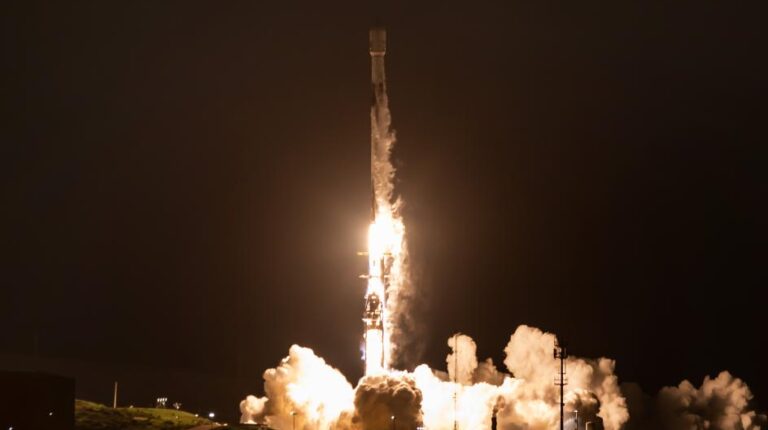
The third satellite of the COSMO-SkyMed Second Generation (CSG) Earth observation constellation has been successfully launched, strengthening the continuity and performance of Italy’s space-based radar monitoring capabilities.
The satellite, owned by the Italian Space Agency (ASI) and the Italian Ministry of Defense, was launched from Vandenberg Space Force Base in California aboard a SpaceX Falcon 9 rocket. The satellite was built and operated by Thales Alenia Space and Telespazio respectively – joint ventures between Thales and Leonardo. The spacecraft made first contact 59 minutes after separation, with signal acquisition carried out at Telespazio’s Fucino Space Center in Abruzzo, Italy. The launch and early orbit phase (LEOP) is expected to last around nine days.
What’s next for COSMO-SkyMed?
COSMO-SkyMed is a dual-use constellation providing synthetic aperture radar (SAR) data for environmental monitoring, meteorology, security and emergency response. The new satellite will ensure operational continuity while progressively replacing the first-generation system, which entered service in 2007.
With three Second Generation satellites now in orbit, the constellation is moving closer to its final configuration of four spacecraft. Once fully deployed, CSG will deliver enhanced image quality, wider area coverage and greater operational flexibility than the original system.
Massimo Claudio Comparini, managing director of Leonardo’s Space Division, said, “Earth observation and the data it provides are a strategic asset for security and sustainability, enabling increasingly targeted and timely services and interventions. This commitment strengthens Italy’s role in space and helps generate value for the country and the international community.”
Giampiero Di Paolo, CEO of Thales Alenia Space Italy, added, “Once fully deployed with its four satellites, [the constellation] will provide substantial technological and performance progress, strengthening our leadership in space-based Earth observation infrastructure.”
Since the launch of the first COSMO-SkyMed satellite, the system has acquired around 4.3 million images, supporting applications ranging from environmental and territorial monitoring to disaster response. As a contributing mission to Europe’s Copernicus program, COSMO-SkyMed data is used by the European Commission’s Emergency Rapid Mapping service to generate satellite maps of areas affected by natural disasters and humanitarian crises within hours.
Italian industry plays a central role in the program. Thales Alenia Space is responsible for overall system development and satellite manufacturing, while Telespazio manages ground segment operations and mission control. Leonardo supplies key onboard systems, including attitude control and power management equipment. Commercial distribution of COSMO-SkyMed data is handled globally by e-GEOS.
In related news, the UK is to strengthen climate observations and satellite functions with £17m space innovation investment