



Scientists from the US National Science Foundation (NSF) National Solar Observatory (NSO) and New Jersey Institute of Technology (NJIT) have leveraged ‘coronal adaptive optics’ technology to produce what they state to be the clearest images and videos of fine-structure in the corona to date. This development is expected to open the door for deeper insights into the corona’s behavior and the processes driving space weather, which were previously obscured by turbulence in the Earth’s atmosphere.
The paper describing this study, Observations of fine coronal structures with high-order solar adaptive optics, is now available in Nature Astronomy. The authors were Dirk Schmidt (NSO), Thomas A. Schad (NSO), Vasyl Yurchyshyn (NJIT), Nicolas Gorceix (NJIT), Thomas R. Rimmele (NSO) and Philip R. Goode (NJIT).
Addressing the blur
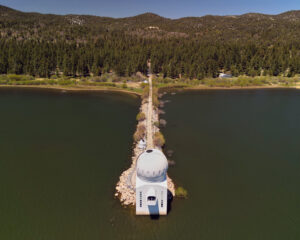
The steady temperature of the water surface helps keep the air around the telescope calm, reducing the optical effects of turbulent air that degrades the telescope’s images of the Sun and that the adaptive optics further removes to achieve the maximum image detail.
The GST is the second-largest solar telescope in the world and home to several instruments that scientists use to analyze the light from the Sun to infer physical processes in the Sun.
The NSF National Solar Observatory and the Big Bear Solar Observatory have collaborated for over two decades to develop and advance adaptive optics technologies for solar observations. The GST has been a critical facility to develop and test prototypes for the US National Science Foundation’s 4m Daniel K Inouye Solar Telescope, which took over as the world’s largest solar telescope in 2019. GST’s first-ever coronal adaptive optics system is the latest product of this successful and pioneering collaboration.
Credit: Sergey Shumko
Funded by the NSF and installed at the 1.6m Goode Solar Telescope (GST), operated by NJIT’s Center for Solar-Terrestrial Research (CSTR) at Big Bear Solar Observatory (BBSO) in California, Cona – the adaptive optics system responsible for these new images – compensates for the blur caused by air turbulence in the Earth’s atmosphere, similar to the bumpy air passengers feel during a flight.
“The turbulence in the air severely degrades images of objects in space, like our Sun, seen through our telescopes. But we can correct for that,” said Dirk Schmidt, adaptive optics scientist at NSO who led the development.
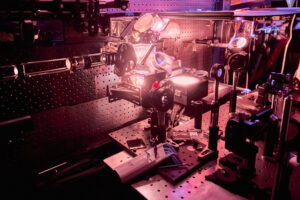
Credit: Dirk Schmidt
Detailed coronal images
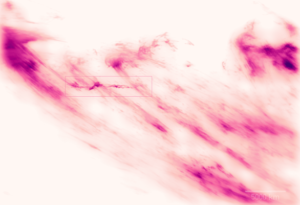
This image was taken by the Goode Solar Telescope at Big Bear Solar Observatory using the new coronal adaptive optics system Cona. The image shows the hydrogen-alpha light emitted by the solar plasma. The image is artificially colorized, yet based on the color of hydrogen-alpha light, and darker color is brighter light.
Credit: Schmidt et al./NJIT/NSO/AURA/NSF
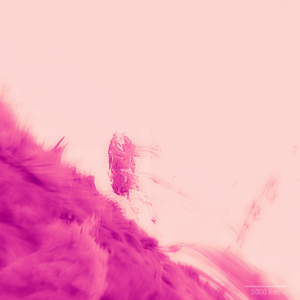
The Sun’s fluffy-looking surface is covered by ‘spicules’, short-lived plasma
jets, whose creation is still subject of scientific debate. The streaks on the right of this image are coronal rain falling down onto the Sun’s surface.
This image was taken by the Goode Solar Telescope at Big Bear Solar Observatory using the new coronal adaptive optics system Cona. The image shows the hydrogen-alpha light emitted by the solar plasma. The image is artificially colorized, yet based on the color of hydrogen-alpha light, and darker color is brighter light.
Credit: Schmidt et al./NJIT/NSO/AURA/NSF
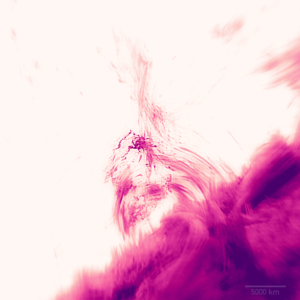
This image was taken by the Goode Solar Telescope at Big Bear Solar Observatory using the new coronal adaptive optics system Cona. The image shows the hydrogen-alpha light emitted by the solar plasma. The image is artificially colorized, yet based on the color of hydrogen-alpha light, and darker color is brighter light.
Credit: Schmidt et al./NJIT/NSO/AURA/NSF

The Sun’s fluffy-looking surface is covered by ‘spicules’, short-lived plasma
jets, whose creation is still the subject of scientific debate.
This image was taken by the Goode Solar Telescope at Big Bear Solar Observatory using the new coronal adaptive optics system Cona. The image shows the hydrogen-alpha light emitted by the solar plasma. The image is artificially colorized, yet based on the color of hydrogen-alpha light, and darker color is brighter light.
Credit: Schmidt et al./NJIT/NSO/AURA/NSF
Among the team’s observations is a movie of a quickly restructuring solar prominence unveiling fine, turbulent internal flows.
A second movie replays the rapid formation and collapse of a finely structured plasma stream. “These are by far the most detailed observations of this kind, showing features not previously observed, and it’s not quite clear what they are,” commented Vasyl Yurchyshyn, co-author of the study and NJIT-CSTR research professor. Schmidt added, “It is super exciting to build an instrument that shows us the Sun like never before.”
A third movie shows fine strands of coronal rain – a phenomenon where cooling plasma condenses and falls back toward the Sun’s surface. “Raindrops in the Sun’s corona can be narrower than 20km,” said Thomas Schad, astronomer at NSO. “These findings offer new invaluable observational insight that is vital to test computer models of coronal processes.”
Another movie shows the dramatic motion of a solar prominence being shaped by the Sun’s magnetism.
A breakthrough in solar adaptive optics
The scientists assert that resolving the structure and dynamics of the cooler plasma at small scales holds a key to answering the coronal heating mystery and improving the understanding of eruptions that eject plasma into space driving space weather – that is, the conditions in Earth’s near-space environment primarily influenced by the Sun’s activity (e.g., solar flares, coronal mass ejections, and the solar wind) that can affect technology and systems on Earth and in space. The team also points out that the precision required demands large telescopes and adaptive optics systems like the one developed by this team.
The GST system Cona uses a mirror that continuously reshapes itself 2,200 times per second to counteract the image degradation caused by turbulent air. Nicolas Gorceix, optical engineer and chief observer at BBSO, said, “Adaptive optics is like a pumped-up autofocus and optical image stabilization in your smartphone camera, but correcting for the errors in the atmosphere rather than the user’s shaky hands.”
Since the early 2000s, adaptive optics have been used in large solar telescopes to restore images of the Sun’s surface to their full potential, enabling telescopes to reach their theoretical diffraction limits – that is, the theoretical maximum resolution of an optical system. These systems have since revolutionized observing the Sun’s surface, but until now, have not been useful for observations in the corona; and the resolution of features beyond the solar limb stagnated at an order of 1,000km or worse – levels achieved 80 years ago.
“The new coronal adaptive optics system closes this decades-old gap and delivers images of coronal features at 63km resolution – the theoretical limit of the 1.6m Goode Solar Telescope,” said Thomas Rimmele, chief technologist at NSO who built the first operational adaptive optics for the Sun’s surface, and motivated the development.
Implications for the future
Coronal adaptive optics is now available at the GST. Schmidt said, “This technological advancement is a game-changer, there is a lot to discover when you boost your resolution by a factor of 10.”
The team now knows how to overcome the resolution limit imposed by the Earth’s lowest region of the atmosphere – the troposphere – on observations beyond the solar limb and is working to apply the technology at the 4m NSF Daniel K Inouye Solar Telescope, built and operated by the NSO in Maui, Hawaiʻi, because the world’s largest solar telescope would see even smaller details in the Sun’s atmosphere.
“This transformative technology, which is likely to be adopted at observatories world-wide, is poised to reshape ground-based solar astronomy,” said Philip R Goode, distinguished research professor of physics at NJIT-CSTR and former director at BBSO, who co-authored the study. “With coronal adaptive optics now in operation, this marks the beginning of a new era in solar physics, promising many more discoveries in the years and decades to come.”
In related news, the Polarimeter to Unify the Corona and Heliosphere (PUNCH) mission recently collected its first images following its launch into polar orbit around the Earth. The mission’s four small spacecraft will act as a single virtual instrument 8,000 miles across to image the solar corona, the Sun’s outer atmosphere, as it transitions into the solar wind that fills and defines our solar system. Click here to read the full story