


Meteorological Technology International
  • News
    • A-E
      • Agriculture
      • Automated Weather Stations
      • Aviation
      • Climate Measurement
      • Data
      • Developing Countries
      • Digital Applications
      • Early Warning Systems
      • Extreme Weather
    • G-P
      • Hydrology
      • Lidar
      • Lightning Detection
      • New Appointments
      • Nowcasting
      • Numerical Weather Prediction
      • Polar Weather
    • R-S
      • Radar
      • Rainfall
      • Remote Sensing
      • Renewable Energy
      • Satellites
      • Solar
      • Space Weather
      • Supercomputers
    • T-Z
      • Training
      • Transport
      • Weather Instruments
      • Wind
      • World Meteorological Organization
      • Meteorological Technology World Expo
  • Features
  • Online Magazines
    • January 2026
    • April 2025
    • January 2025
    • September 2024
    • April 2024
    • Archive Issues
    • Subscribe Free!
  • Opinion
  • Videos
  • Supplier Spotlight
  • Expo
LinkedIn Twitter Facebook
  • Sign-up for Free Weekly E-Newsletter
  • Meet the Editors
  • Contact Us
  • Media Pack
LinkedIn Facebook
Subscribe
Meteorological Technology International
  • News
      • Agriculture
      • Automated Weather Stations
      • Aviation
      • Climate Measurement
      • Data
      • Developing Countries
      • Digital Applications
      • Early Warning Systems
      • Extreme Weather
      • Hydrology
      • Lidar
      • Lightning Detection
      • New Appointments
      • Nowcasting
      • Numerical Weather Prediction
      • Polar Weather
      • Radar
      • Rainfall
      • Remote Sensing
      • Renewable Energy
      • Satellites
      • Solar
      • Space Weather
      • Supercomputers
      • Training
      • Transport
      • Weather Instruments
      • Wind
      • World Meteorological Organization
      • Meteorological Technology World Expo
  • Features
  • Online Magazines
    1. January 2026
    2. September 2025
    3. April 2025
    4. January 2025
    5. September 2024
    6. April 2024
    7. January 2024
    8. September 2023
    9. April 2023
    10. Archive Issues
    11. Subscribe Free!
    Featured
    November 27, 2025

    In this Issue – January 2026

    By Hazel KingNovember 27, 2025
    Recent

    In this Issue – January 2026

    November 27, 2025

    In this Issue – September 2025

    August 11, 2025

    In this Issue – April 2025

    April 15, 2025
  • Opinion
  • Videos
  • Supplier Spotlight
  • Expo
Facebook LinkedIn
Subscribe
Meteorological Technology International
Oceans

NOC deploys robots to investigate ocean’s biological carbon pump

Elizabeth BakerBy Elizabeth BakerMay 28, 20254 Mins Read
Share LinkedIn Facebook Twitter Email
As part of a year-long experiment led by scientists from the UK’s National Oceanography Centre (NOC), a fleet of ocean robots and instruments has been deployed to explore the climate-regulating mechanism at the depths of the Labrador Sea.
Dr Louis Clément, ReBELS co-investigator
Share
LinkedIn Facebook Twitter Email

As part of a year-long experiment led by scientists from the UK’s National Oceanography Centre (NOC), a fleet of ocean robots and instruments has been deployed to explore the climate-regulating mechanism at the depths of the Labrador Sea.

Project goals

The ReBELS project (Resolving Biological Carbon Export in the Labrador Sea) is a four-year program funded by the Natural Environment Research Council (NERC). By deploying technology, the project is investigating the biological carbon pump, an ocean process that helps remove carbon dioxide from the atmosphere and store it in the deep sea; without it, atmospheric CO2 would be 50% higher. The aim is to provide new insights into the ocean’s important climate-regulating mechanism and improve the ability to predict and respond to global climate change.

Using a combination of moored sensors, drifting profiling floats and autonomous underwater vehicles, the project seeks to understand how carbon-rich particles sink through the water column and how physical ocean processes, such as deep convection currents, might enhance carbon storage in this remote and understudied region.

Technology deployed

Two FluxCAM marine snow camera systems were installed on a deep-sea mooring in the Labrador Sea to measure the sinking speeds of different-sized particles and reduce uncertainties about how much carbon the ocean absorbs from the atmosphere. The cameras were fixed at depths of 100-300m on a 3,300m-long mooring in the sea between Newfoundland and Greenland. They were deployed with a specially programmed drifting profiling float and autonomous underwater gliders, which will measure ocean properties and carbon flux for five to six months.
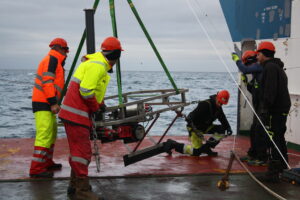
Deployment of the FluxCAM. Credit: NOC

“The biological carbon pump plays a crucial role in regulating Earth’s climate,” said Dr Filipa Carvalho, project lead at NOC. “Microscopic marine plants, known as phytoplankton, absorb carbon dioxide from the atmosphere and convert it into organic material.

“This material is then consumed by marine organisms, with remnants eventually sinking as ‘marine snow’ – tiny carbon-rich particles that settle in the deep ocean, where the carbon can be stored for centuries.

“However, the rate at which these particles sink and how much carbon is ultimately locked away remain uncertain. The ReBELS project is using cutting-edge technology to answer these questions. This combination of fixed and mobile instruments will allow us to track how carbon is transported and transformed in the Labrador Sea over time.”

The ReBELS float has been programmed to carry out more frequent and varied depth profiles than standard floats and is also equipped with advanced sensors, including an optical sediment trap to help researchers understand the amount of sinking particles when the float is drifting at the same depth.

One of the gliders will stay near the mooring while another will follow a drifting profiling float, capturing detailed, high-resolution data on particle movement, ocean circulation and biological activity.
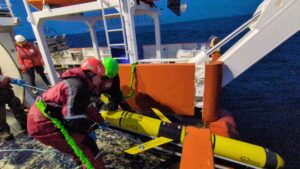
Deployment underway. Credit: Alexander Cerra

“This combination of moored sensors, drifting instruments and mobile gliders is designed to overcome the challenges of studying carbon flux in the ocean,” added Dr Louis Clément, co-investigator and also at NOC.

“While moored instruments provide long-term, fixed-location data, they do not capture the movement of water masses. The drifting float follows ocean currents, providing a dynamic perspective on sinking particles, while the gliders add another layer of insight, especially into small-scale turbulence effects on the biological carbon pump. By integrating data from these platforms, we hope to build the most accurate picture yet of carbon transport and storage in the Labrador Sea.”

In related news, Caltech recently conducted a research project using the submarine robot CARL-Bot (Caltech Autonomous Reinforcement Learning roBot) to study how ‘vortex rings’ in the oceans could help small autonomous underwater vehicles navigate better, and therefore improve their measurements of the deep. Click here to read the full story.

Previous ArticleCoronal adaptive optics reveal most detailed coronal images to date
Next Article SOFF Steering Committee moves to mobilize US$200m

Read Similar Stories

Climate Measurement

UK to strengthen climate observations and satellite functions with £17m space innovation investment

December 4, 20253 Mins Read
Climate Measurement

Uncrewed systems prove new method for observing deep ocean currents in real time

December 4, 20253 Mins Read
Climate Measurement

WMO predicts borderline La Niña conditions

December 4, 20252 Mins Read
Latest News

UK to strengthen climate observations and satellite functions with £17m space innovation investment

December 4, 2025

Uncrewed systems prove new method for observing deep ocean currents in real time

December 4, 2025

WMO predicts borderline La Niña conditions

December 4, 2025

Receive breaking stories and features in your inbox each week, for free


Enter your email address:


Supplier Spotlights
  • EWR Radar Systems
Getting in Touch
  • Contact Us / Advertise
  • Meet the Editors
  • Download Media Pack
  • Free Weekly E-Newsletter
Our Social Channels
  • Facebook
  • LinkedIn
© 2025 UKi Media & Events a division of UKIP Media & Events Ltd
  • Cookie Policy
  • Privacy Policy
  • Terms and Conditions
  • Notice and Takedown Policy

Type above and press Enter to search. Press Esc to cancel.

We use cookies on our website to give you the most relevant experience by remembering your preferences and repeat visits. By clicking “Accept”, you consent to the use of ALL the cookies.
Cookie settingsACCEPT
Manage consent

Privacy Overview

This website uses cookies to improve your experience while you navigate through the website. Out of these, the cookies that are categorized as necessary are stored on your browser as they are essential for the working of basic functionalities of the website. We also use third-party cookies that help us analyze and understand how you use this website. These cookies will be stored in your browser only with your consent. You also have the option to opt-out of these cookies. But opting out of some of these cookies may affect your browsing experience.
Necessary
Always Enabled

Necessary cookies are absolutely essential for the website to function properly. These cookies ensure basic functionalities and security features of the website, anonymously.

CookieDurationDescription
cookielawinfo-checbox-analytics11 monthsThis cookie is set by GDPR Cookie Consent plugin. The cookie is used to store the user consent for the cookies in the category "Analytics".
cookielawinfo-checbox-functional11 monthsThe cookie is set by GDPR cookie consent to record the user consent for the cookies in the category "Functional".
cookielawinfo-checbox-others11 monthsThis cookie is set by GDPR Cookie Consent plugin. The cookie is used to store the user consent for the cookies in the category "Other.
cookielawinfo-checkbox-necessary11 monthsThis cookie is set by GDPR Cookie Consent plugin. The cookies is used to store the user consent for the cookies in the category "Necessary".
cookielawinfo-checkbox-performance11 monthsThis cookie is set by GDPR Cookie Consent plugin. The cookie is used to store the user consent for the cookies in the category "Performance".
viewed_cookie_policy11 monthsThe cookie is set by the GDPR Cookie Consent plugin and is used to store whether or not user has consented to the use of cookies. It does not store any personal data.

Functional

Functional cookies help to perform certain functionalities like sharing the content of the website on social media platforms, collect feedbacks, and other third-party features.

Performance

Performance cookies are used to understand and analyze the key performance indexes of the website which helps in delivering a better user experience for the visitors.

Analytics

Analytical cookies are used to understand how visitors interact with the website. These cookies help provide information on metrics the number of visitors, bounce rate, traffic source, etc.

Advertisement

Advertisement cookies are used to provide visitors with relevant ads and marketing campaigns. These cookies track visitors across websites and collect information to provide customized ads.

Others

Other uncategorized cookies are those that are being analyzed and have not been classified into a category as yet.

SAVE & ACCEPT
Powered by