


Close Menu
Meteorological Technology International
  • News
    • A-E
      • Agriculture
      • Automated Weather Stations
      • Aviation
      • Climate Measurement
      • Data
      • Developing Countries
      • Digital Applications
      • Early Warning Systems
      • Extreme Weather
    • G-P
      • Hydrology
      • Lidar
      • Lightning Detection
      • New Appointments
      • Nowcasting
      • Numerical Weather Prediction
      • Polar Weather
    • R-S
      • Radar
      • Rainfall
      • Remote Sensing
      • Renewable Energy
      • Satellites
      • Solar
      • Space Weather
      • Supercomputers
    • T-Z
      • Training
      • Transport
      • Weather Instruments
      • Wind
      • World Meteorological Organization
      • Meteorological Technology World Expo
  • Features
  • Online Magazines
    • January 2026
    • April 2025
    • January 2025
    • September 2024
    • April 2024
    • Archive Issues
    • Subscribe Free!
  • Opinion
  • Videos
  • Supplier Spotlight
  • Expo
LinkedIn X (Twitter) Facebook
  • Sign-up for Free Weekly E-Newsletter
  • Meet the Editors
  • Contact Us
  • Media Pack
LinkedIn Facebook
Subscribe
Meteorological Technology International
  • News
      • Agriculture
      • Automated Weather Stations
      • Aviation
      • Climate Measurement
      • Data
      • Developing Countries
      • Digital Applications
      • Early Warning Systems
      • Extreme Weather
      • Hydrology
      • Lidar
      • Lightning Detection
      • New Appointments
      • Nowcasting
      • Numerical Weather Prediction
      • Polar Weather
      • Radar
      • Rainfall
      • Remote Sensing
      • Renewable Energy
      • Satellites
      • Solar
      • Space Weather
      • Supercomputers
      • Training
      • Transport
      • Weather Instruments
      • Wind
      • World Meteorological Organization
      • Meteorological Technology World Expo
  • Features
  • Online Magazines
    1. April 2026
    2. January 2026
    3. September 2025
    4. April 2025
    5. January 2025
    6. September 2024
    7. April 2024
    8. January 2024
    9. Archive Issues
    10. Subscribe Free!
    Featured
    May 5, 2026

    In this Issue – April 2026

    By Web TeamMay 5, 2026
    Recent

    In this Issue – April 2026

    May 5, 2026

    In this Issue – January 2026

    November 27, 2025

    In this Issue – September 2025

    August 11, 2025
  • Opinion
  • Videos
  • Supplier Spotlight
  • Expo
Facebook LinkedIn
Subscribe
Meteorological Technology International
Space Weather

Gravity waves drive latitudinal air currents on Mars, University of Tokyo’s atmospheric data study reveals

Elizabeth BakerBy Elizabeth BakerMarch 7, 20253 Mins Read
Share LinkedIn Facebook Twitter Email
A new study by researchers including those at the University of Tokyo studied long-term atmospheric data to reveal that atmospheric gravity waves play a crucial role in driving latitudinal air currents on Mars, particularly at high altitudes.
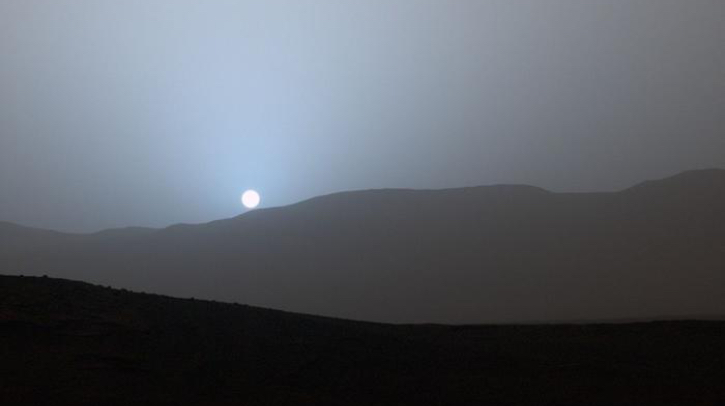
The thermal impact of dust storms on Mars is significant, and is thought to play a similar role to that of water vapor in Earth’s atmosphere. Credit: NASA CC0
Share
LinkedIn Facebook Twitter Email

A new study by researchers, including those at the University of Tokyo, studied long-term atmospheric data to reveal that atmospheric gravity waves play a crucial role in driving latitudinal air currents on Mars, particularly at high altitudes.

According to the researchers, the findings offer a fresh perspective on the behavior of Mars’s middle atmosphere, highlighting fundamental differences from Earth’s. The study applied methods developed to explore Earth’s atmosphere to quantitatively estimate the influence of gravity waves on Mars’s planetary circulation.

“On Earth, large-scale atmospheric waves caused by the planet’s rotation, known as Rossby waves, are the primary influence on the way air circulates in the stratosphere, or the lower part of the middle atmosphere. But our study shows that on Mars, gravity waves (GWs) have a dominant effect at the mid and high latitudes of the middle atmosphere,” said Prof. Kaoru Sato from the University of Tokyo’s Department of Earth and Planetary Science. “Rossby waves are large-scale atmospheric waves, or resolved waves, whereas GWs are unresolved waves, meaning they are too fine to be directly measured or modeled and must be estimated by more indirect means.”

As GWs are an atmospheric phenomenon, when a packet of air rises and falls due to variations in buoyancy, its oscillating motion gives rise to GWs. Due to the small-scale nature of them and the limitations of observational data, researchers have previously found it challenging to quantify their significance in the Martian atmosphere. So Sato and her team turned to the Ensemble Mars Atmosphere Reanalysis System (EMARS) dataset, produced by a range of space-based observations over many years, to analyze seasonal variations up there.

Earth comparisons

“We found something interesting: that GWs facilitate the rapid vertical transfer of angular momentum, significantly influencing the meridional, or north-south, in the middle atmosphere circulations on Mars,” said graduate student Anzu Asumi. “It’s interesting because it more closely resembles the behavior seen in Earth’s mesosphere rather than in our stratosphere. This suggests existing Martian atmospheric circulation models may need to be refined to better incorporate these wave effects, potentially improving future climate and weather simulations.”

The research report also underscored the importance of planetary comparisons in atmospheric science. Mars’s similarity to Earth in terms of rotational speed and axial tilt makes it an ideal test case for studying planetary weather systems. At the same time, its distinct characteristics, such as a thin carbon dioxide-rich atmosphere and pronounced seasonal variations, offer insights into alien atmospheres. By analyzing these differences, researchers can improve their understanding of fundamental atmospheric dynamics, which may ultimately contribute to better climate models for Earth too.

Potential future applications

“Looking ahead, we plan to investigate the impact of Martian dust storms on atmospheric circulation. So far, our analysis has focused on years without major dust storms,” said Sato. “However, these storms dramatically alter atmospheric conditions, and we suspect they may intensify the role of GWs in circulation. Our research lays the groundwork for forecasting Martian weather, which will be essential for ensuring the success of future Mars missions.”

Future studies will examine how these storms lead to significant shifts in global atmospheric patterns. With these advances, the prospect of accurately predicting atmospheric conditions on Mars reportedly moves one step closer to reality.

In related news, an international team of astronomers, including Trottier Institute for Research on Exoplanets (IREx) and Université de Montréal members Joost Wardenier and Romain Allart, recently mapped the 3D structure of the atmosphere of a planet beyond the solar system for the first time. Click here to read the full story.

Previous ArticleAI has ‘great potential’ for detecting wildfires, Universidade Federal do Amazonas finds
Next Article VIDEO: Stratospheric balloon launches from Houston Spaceport

Read Similar Stories

Satellites

SMILE mission launches to study Earth’s magnetic shield and space weather

May 20, 20263 Mins Read
Space Weather

Northumbria University secures £4m to study Earth’s radiation belts

April 16, 20262 Mins Read
Solar

Mauna Loa Solar Observatory reopens to support Artemis II mission

April 8, 20262 Mins Read
Latest News

R.M. Young Company reengineers SNOdar snow-depth sensor

May 21, 2026

SMILE mission launches to study Earth’s magnetic shield and space weather

May 20, 2026

Cloud measurement campaign targets improved climate model accuracy

May 20, 2026

Receive breaking stories and features in your inbox each week, for free


Enter your email address:


Supplier Spotlights
  • Sommer GmbH
Getting in Touch
  • Contact Us / Advertise
  • Meet the Editors
  • Media Pack
  • Free Weekly E-Newsletter
Our Social Channels
  • Facebook
  • LinkedIn
© 2026 UKi Media & Events a division of UKIP Media & Events Ltd
  • Cookie Policy
  • Privacy Policy
  • Terms and Conditions
  • Notice and Takedown Policy

Type above and press Enter to search. Press Esc to cancel.