


According to the latest Global Annual to Decadal Climate Update report by the World Meteorological Organization (WMO), global climate predictions show temperatures are expected to continue at or near record levels in the next five years, increasing climate risks and impacts on societies, economies and sustainable development.
The update was produced by the UK’s Met Office as the WMO Lead Centre for Annual to Decadal Climate Prediction. It provides a synthesis of predictions from WMO-designated Global Producing Centers and other contributing centers.
Key findings
The WMO report has forecast that the annually averaged global mean near-surface temperature for each year between 2025 and 2029 will be between 1.2°C and 1.9°C higher than the average over the years 1850-1900.
There is reportedly an 80% chance that at least one year between 2025 and 2029 will be warmer than the warmest year on record (currently 2024). Additionally, the researchers found an 86% chance that at least one year will be more than 1.5°C above the pre-industrial level. The report does not give global predictions for individual years.
Alongside these findings, there is a forecast 70% chance that the five-year average warming for 2025-2029 will be more than 1.5°C, according to the report. This is up from 47% in last year’s report (for the 2024-2028 period) and up from 32% in the 2023 report for the 2023-2027 period. The research emphasizes that every additional fraction of a degree of warming drives more harmful heat waves, extreme rainfall events, intense droughts, melting of ice sheets, sea ice and glaciers, heating of the ocean and rising sea levels.
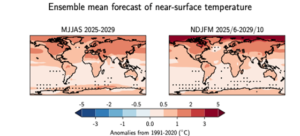
Another key point in the research is that Arctic warming over the next five extended winters (November to March) is predicted to be more than three and a half times the global average, at 2.4°C above the average temperature during the most recent 30-year baseline period (1991-2020). Similarly, predictions of sea ice for March 2025-2029 suggest further reductions in sea-ice concentration in the Barents Sea, Bering Sea and Sea of Okhotsk.
Predicted precipitation patterns for May-September 2025-2029, relative to the 1991-2020 baseline, suggest wetter than average conditions in the Sahel, Northern Europe, Alaska and northern Siberia, and drier than average conditions for this season over the Amazon. Furthermore, recent years, apart from 2023, in the South Asian region were found to be wetter than average and the forecast suggests this will continue for the 2025-2029 period. This may not be the case for all individual seasons in this period.
“We have just experienced the 10 warmest years on record. Unfortunately, this WMO report provides no sign of respite over the coming years, and this means that there will be a growing negative impact on our economies, our daily lives, our ecosystems and our planet,” said WMO deputy secretary-general Ko Barrett. “Continued climate monitoring and prediction are essential to provide decision-makers with science-based tools and information to help us adapt.”
This latest decadal climate forecast predicts that the central estimate of the 20-year average warming for 2015-2034 will be 1.44°C, (with a 90% confidence range of 1.22-1.54°C). A WMO team of international experts has reportedly begun considering all these estimates to ensure consistent, reliable and timely tracking of long-term global temperature changes.
Supporting initiatives
WMO’s State of the Global Climate 2024 report confirmed that 2024 was likely the first calendar year to be more than 1.5°C above the 1850-1900 average, with a global mean near-surface temperature of 1.55 ±0.13 °C above the 1850-1900 average. It also recorded that 2024 was the warmest year in the 175-year observational record.
Under the Paris Agreement, countries agreed to hold the increase in long-term global average surface temperature well below 2°C above pre-industrial levels and to pursue efforts to limit the increase to 1.5°C.
In related news, the 21st Session of the Forum on Regional Climate Monitoring, Assessment and Prediction for Asia (FOCRAII) has taken place in Qingdao, China, on May 14-16, hosted by WMO and the Beijing Climate Centre and sponsored by Shandong Provincial Meteorological Service. Click here to read the full story.