


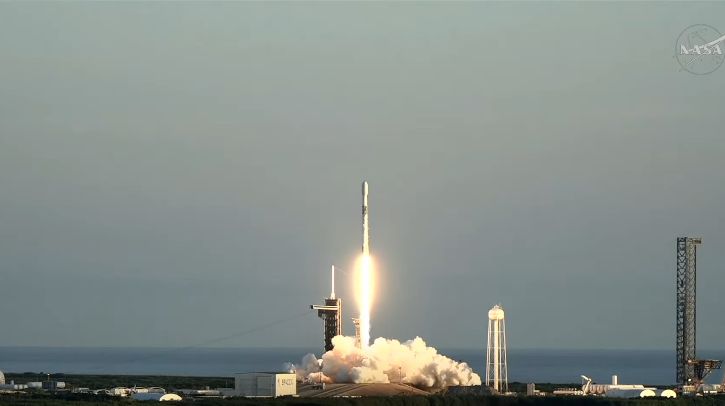
NASA and the NOAA launched three new missions on Wednesday to investigate the sun’s influence across the solar system.
A SpaceX Falcon 9 rocket lifted off from Launch Complex 39A at NASA’s Kennedy Space Center in Florida, carrying the agency’s IMAP (Interstellar Mapping and Acceleration Probe), Carruthers Geocorona Observatory and NOAA’s SWFO-L1 (Space Weather Follow On-Lagrange 1) spacecraft.
NASA says the missions will help protect its ground-based technology and human and robotic space explorers from the harsh conditions of space weather.
Each mission will investigate different effects of space weather and solar wind, examining the continuous stream of particles from their origins at the sun all the way outward to interstellar space.
“These three unique missions will help us get to know our sun and its effects on Earth better than ever before,” explained Joe Westlake, heliophysics division director at NASA Headquarters. “This knowledge is critical because the sun’s activity directly impacts our daily lives, from power grids to GPS. These missions will help us ensure the safety and resilience of our interconnected world.”
Measuring space weather to protect Earth
The IMAP mission will chart the boundary of the heliosphere – a bubble inflated by the solar wind that shields our solar system from galactic cosmic rays – which is a key protection that makes Earth habitable.
The spacecraft will also sample and measure solar wind particles streaming outward from the sun, as well as energetic particles streaming in from the boundary of the solar system and beyond.
The Carruthers Geocorona Observatory is said to be the first mission dedicated to recording changes in the outermost layer of our atmosphere, the exosphere, which plays an important role in Earth’s response to space weather.
By studying the geocorona – the ultraviolet glow given off by the exosphere when sunlight shines on it – the Carruthers mission will reveal how the exosphere responds to solar storms and how it changes with the seasons.
“The Carruthers mission will show us how the exosphere works and will help improve our ability to predict the impacts of solar activity here on Earth,” said Lara Waldrop, the mission’s principal investigator at the University of Illinois at Urbana-Champaign.
The NOAA’s SWFO-L1, which is the first of its kind, is designed to be a full-time operational space weather observatory. It will provide quicker and more accurate space weather forecasts by monitoring the sun’s activity and space conditions near Earth 24/7 without interruption or obstruction.
Next steps
In the hours after launch, it was reported that all three spacecraft successfully deployed from the rocket and sent signals to Earth to confirm they’re active and working well.
Over the next few months, the spacecraft will make their way to their destination – a location between Earth and the sun, about 1,600,000km from our planet, called Lagrange point 1 (L1).
They should arrive by January and, once their instrument checkouts and calibrations are complete, will begin their missions to better understand space weather.
In related news, the NOAA recently awarded a $24m contract to PlantiQ for satellite weather data