


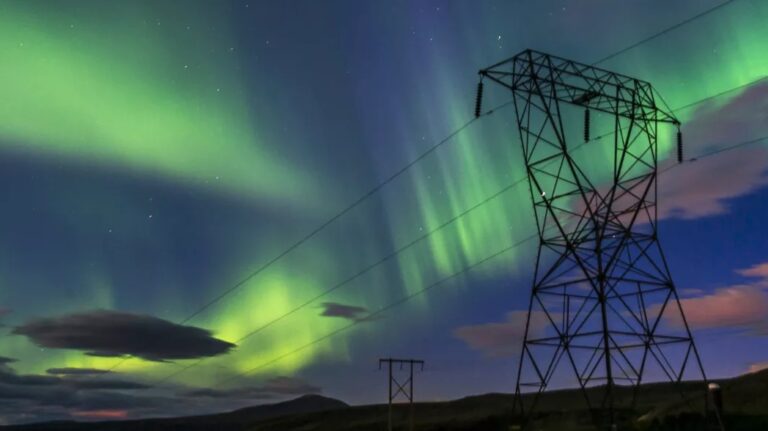
A new generation of quantum sensors have been developed in the UK to provide vital insights into the risks posed by space weather to national infrastructure.
Five quantum magnetometers – instruments of exceptional sensitivity that can detect minute variations in the Earth’s magnetic field – have been installed across the UK for the first time, delivering complete national coverage.
Funded by UK Research and Innovation (UKRI), the sensors were developed and optimized by the University of Strathclyde and the Science and Technology Facilities Council’s (STFC) RAL Space through the UK National Quantum Technology Programme’s Quantum Technology Hub in Sensors and Timing.
They will generate high-resolution data to support the British Geological Survey (BGS) in monitoring and understanding the impact of extreme magnetic storms. During such storms, the geomagnetic field can fluctuate with enough intensity to disrupt power grids, satellite navigation and railway signalling.
While the UK’s three established geomagnetic observatories have provided valuable national-scale monitoring, they cannot capture local variations. The newly deployed Strathclyde-built magnetometers, sited at Aberystwyth, Boulby in North Yorkshire, Blickling in Norfolk, Chilbolton Observatory in Hampshire and Thurso, are designed to address this gap.
Dr Stuart Ingleby from the Department of Physics at the University of Strathclyde said, “By enabling more detailed observation of geomagnetic storms, we are improving the evidence base that informs how government, industry and society can prepare for and respond to space weather events. This reflects Strathclyde’s wider role as a leader in translating quantum science into practical tools for resilience and security.”
Dr Ciarán Beggan, geophysicist at BGS, added, “These new measurements will greatly enhance our understanding of how extreme magnetic storms impact different parts of the country. This means that society in general will have access to the advice and information needed to understand where we are vulnerable to magnetic storms and to make informed decisions on how to mitigate against them.”