


Close Menu
Meteorological Technology International
  • News
    • A-E
      • Agriculture
      • Automated Weather Stations
      • Aviation
      • Climate Measurement
      • Data
      • Developing Countries
      • Digital Applications
      • Early Warning Systems
      • Extreme Weather
    • G-P
      • Hydrology
      • Lidar
      • Lightning Detection
      • New Appointments
      • Nowcasting
      • Numerical Weather Prediction
      • Polar Weather
    • R-S
      • Radar
      • Rainfall
      • Remote Sensing
      • Renewable Energy
      • Satellites
      • Solar
      • Space Weather
      • Supercomputers
    • T-Z
      • Training
      • Transport
      • Weather Instruments
      • Wind
      • World Meteorological Organization
      • Meteorological Technology World Expo
  • Features
  • Online Magazines
    • January 2026
    • April 2025
    • January 2025
    • September 2024
    • April 2024
    • Archive Issues
    • Subscribe Free!
  • Opinion
  • Videos
  • Supplier Spotlight
  • Expo
LinkedIn X (Twitter) Facebook
  • Sign-up for Free Weekly E-Newsletter
  • Meet the Editors
  • Contact Us
  • Media Pack
LinkedIn Facebook
Subscribe
Meteorological Technology International
  • News
      • Agriculture
      • Automated Weather Stations
      • Aviation
      • Climate Measurement
      • Data
      • Developing Countries
      • Digital Applications
      • Early Warning Systems
      • Extreme Weather
      • Hydrology
      • Lidar
      • Lightning Detection
      • New Appointments
      • Nowcasting
      • Numerical Weather Prediction
      • Polar Weather
      • Radar
      • Rainfall
      • Remote Sensing
      • Renewable Energy
      • Satellites
      • Solar
      • Space Weather
      • Supercomputers
      • Training
      • Transport
      • Weather Instruments
      • Wind
      • World Meteorological Organization
      • Meteorological Technology World Expo
  • Features
  • Online Magazines
    1. April 2026
    2. January 2026
    3. September 2025
    4. April 2025
    5. January 2025
    6. September 2024
    7. April 2024
    8. January 2024
    9. Archive Issues
    10. Subscribe Free!
    Featured
    May 5, 2026

    In this Issue – April 2026

    By Web TeamMay 5, 2026
    Recent

    In this Issue – April 2026

    May 5, 2026

    In this Issue – January 2026

    November 27, 2025

    In this Issue – September 2025

    August 11, 2025
  • Opinion
  • Videos
  • Supplier Spotlight
  • Expo
Facebook LinkedIn
Subscribe
Meteorological Technology International
News

NASA is using AI to calibrate Atmospheric Imagery Assembly for better space weather prediction

Helen NormanBy Helen NormanJuly 28, 20213 Mins Read
Share LinkedIn Facebook Twitter Email
Share
LinkedIn Facebook Twitter Email

A group of researchers is using artificial intelligence (AI) techniques to calibrate some of NASA’s images of the Sun, helping improve the data that scientists use for solar research.

Launched in 2010, NASA’s Solar Dynamics Observatory (SDO) has provided high-definition images of the Sun for over a decade. Its images have given scientists a detailed look at various solar phenomena that can spark space weather and affect astronauts and technology on Earth and in space.

The Atmospheric Imagery Assembly (AIA) is one of two imaging instruments on SDO and looks constantly at the Sun, taking images across 10 wavelengths of ultraviolet light every 12 seconds. This creates a wealth of information of the Sun, but AIA degrades over time, and the data needs to be frequently calibrated.
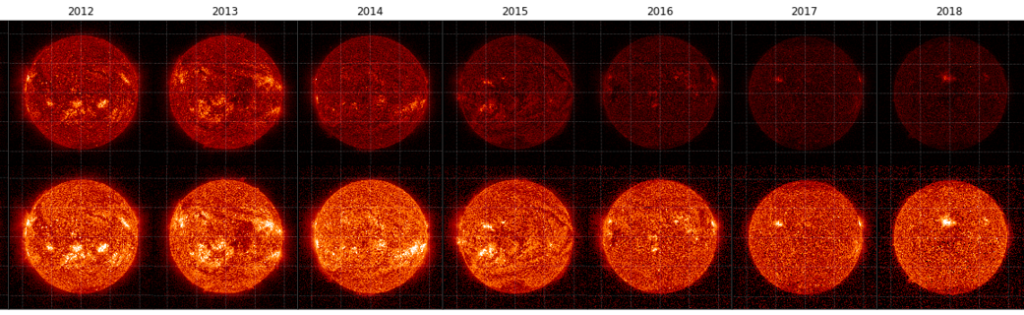
The top row of images show the degradation of AIA’s 304 Angstrom wavelength channel over the years since SDO’s launch. The bottom row of images are corrected for this degradation using a machine learning algorithm. Credits: Luiz Dos Santos/NASA GSFC

Since SDO’s launch, scientists have used sounding rockets to calibrate AIA. For calibration, scientists attach an ultraviolet telescope to a sounding rocket and compare that data to the measurements from AIA. Scientists can then make adjustments to account for any changes in AIA’s data.

There are some drawbacks to the sounding rocket method of calibration. Sounding rockets can only launch so often, but AIA is constantly looking at the Sun. That means there’s downtime where the calibration is slightly off in between each sounding rocket calibration.

“It’s also important for deep space missions, which won’t have the option of sounding rocket calibration,” said Dr Luiz Dos Santos, a solar physicist at NASA’s Goddard Space Flight Center. “We’re tackling two problems at once.”

With these challenges in mind, scientists decided to look at how machine learning could calibrate the instrument, with an eye toward constant calibration.

First, researchers needed to train a machine learning algorithm to recognize solar structures and how to compare them using AIA data. To do this, they give the algorithm images from sounding rocket calibration flights and tell it the correct amount of calibration they need. After enough of these examples, they give the algorithm similar images and see if it would identify the correct calibration needed. With enough data, the algorithm learns to identify how much calibration is needed for each image.

Because AIA looks at the Sun in multiple wavelengths of light, researchers can also use the algorithm to compare specific structures across the wavelengths and strengthen its assessments.

To start, they would teach the algorithm what a solar flare looked like by showing it solar flares across all of AIA’s wavelengths until it recognized solar flares in all different types of light. Once the program can recognize a solar flare without any degradation, the algorithm can then determine how much degradation is affecting AIA’s current images and how much calibration is needed for each.

“This was the big thing,” Dos Santos added. “Instead of just identifying it on the same wavelength, we’re identifying structures across the wavelengths.”

This means researchers can be sure of the calibration the algorithm identified. Indeed, when comparing their virtual calibration data to the sounding rocket calibration data, the machine learning program was spot on.

With this new process, researchers are poised to constantly calibrate AIA’s images between calibration rocket flights, improving the accuracy of SDO’s data for researchers.

Previous ArticleBushfires, not pandemic lockdowns, had biggest impact on global climate in 2020
Next Article UAE National Center of Meteorology opens new Science Dome

Read Similar Stories

Solar

New forecasting framework targets solar-limb flare blind spot

June 4, 20262 Mins Read
Satellites

SMILE mission launches to study Earth’s magnetic shield and space weather

May 20, 20263 Mins Read
Space Weather

Northumbria University secures £4m to study Earth’s radiation belts

April 16, 20262 Mins Read
Latest News

VIDEO: Sentinel-6 satellite detects El Niño precursor in Pacific

June 4, 2026

New forecasting framework targets solar-limb flare blind spot

June 4, 2026

Colorado State University and Nvidia partner to extend severe storm prediction lead times

June 2, 2026

Receive breaking stories and features in your inbox each week, for free


Enter your email address:


Supplier Spotlights
  • EWR Radar Systems
Getting in Touch
  • Contact Us / Advertise
  • Meet the Editors
  • Media Pack
  • Free Weekly E-Newsletter
Our Social Channels
  • Facebook
  • LinkedIn
© 2026 UKi Media & Events a division of UKIP Media & Events Ltd
  • Cookie Policy
  • Privacy Policy
  • Terms and Conditions
  • Notice and Takedown Policy

Type above and press Enter to search. Press Esc to cancel.