


Meteorological Technology International
  • News
    • A-E
      • Agriculture
      • Automated Weather Stations
      • Aviation
      • Climate Measurement
      • Data
      • Developing Countries
      • Digital Applications
      • Early Warning Systems
      • Extreme Weather
    • G-P
      • Hydrology
      • Lidar
      • Lightning Detection
      • New Appointments
      • Nowcasting
      • Numerical Weather Prediction
      • Polar Weather
    • R-S
      • Radar
      • Rainfall
      • Remote Sensing
      • Renewable Energy
      • Satellites
      • Solar
      • Space Weather
      • Supercomputers
    • T-Z
      • Training
      • Transport
      • Weather Instruments
      • Wind
      • World Meteorological Organization
      • Meteorological Technology World Expo
  • Features
  • Online Magazines
    • January 2026
    • April 2025
    • January 2025
    • September 2024
    • April 2024
    • Archive Issues
    • Subscribe Free!
  • Opinion
  • Videos
  • Supplier Spotlight
  • Expo
LinkedIn Twitter Facebook
  • Sign-up for Free Weekly E-Newsletter
  • Meet the Editors
  • Contact Us
  • Media Pack
LinkedIn Facebook
Subscribe
Meteorological Technology International
  • News
      • Agriculture
      • Automated Weather Stations
      • Aviation
      • Climate Measurement
      • Data
      • Developing Countries
      • Digital Applications
      • Early Warning Systems
      • Extreme Weather
      • Hydrology
      • Lidar
      • Lightning Detection
      • New Appointments
      • Nowcasting
      • Numerical Weather Prediction
      • Polar Weather
      • Radar
      • Rainfall
      • Remote Sensing
      • Renewable Energy
      • Satellites
      • Solar
      • Space Weather
      • Supercomputers
      • Training
      • Transport
      • Weather Instruments
      • Wind
      • World Meteorological Organization
      • Meteorological Technology World Expo
  • Features
  • Online Magazines
    1. January 2026
    2. September 2025
    3. April 2025
    4. January 2025
    5. September 2024
    6. April 2024
    7. January 2024
    8. September 2023
    9. April 2023
    10. Archive Issues
    11. Subscribe Free!
    Featured
    November 27, 2025

    In this Issue – January 2026

    By Hazel KingNovember 27, 2025
    Recent

    In this Issue – January 2026

    November 27, 2025

    In this Issue – September 2025

    August 11, 2025

    In this Issue – April 2025

    April 15, 2025
  • Opinion
  • Videos
  • Supplier Spotlight
  • Expo
Facebook LinkedIn
Subscribe
Meteorological Technology International
Solar

Sun’s activity is increasing, according to NASA study

Alex PackBy Alex PackSeptember 17, 20254 Mins Read
Share LinkedIn Facebook Twitter Email
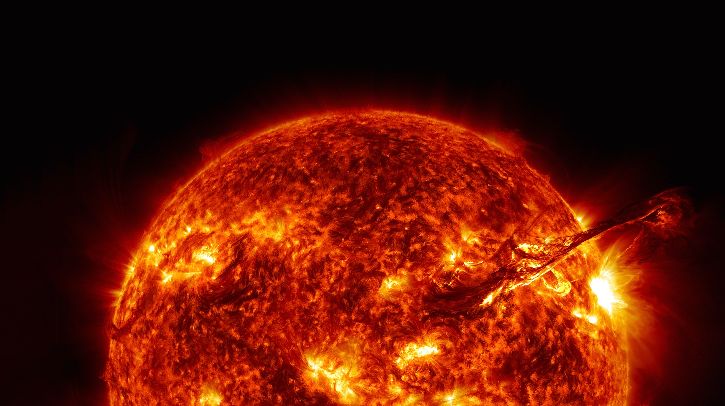
A close up of the sun viewed from the space, with solar storms and flares visible across its surface. Space is dark and black in the background
Share
LinkedIn Facebook Twitter Email

A new NASA study shows the sun has become increasingly active since 2008, which researchers say could lead to an uptick in space weather events such as solar storms, flares and coronal mass ejections.

Although solar activity is known to fluctuate in cycles of 11 years, there can be long-term variations that last decades, and since the 1980s, the amount of solar activity had been steadily decreasing up to 2008 where solar activity was the weakest on record.

Scientists had expected the sun to be entering a period of historically low activity, but the sun has reversed course, according to the study, which appears in The Astrophysical Journal Letters.

“All signs were pointing to the sun going into a prolonged phase of low activity,” said Jamie Jasinski of NASA’s Jet Propulsion Laboratory in Southern California and lead author of the new study. “So it was a surprise to see that trend reversed. The sun is slowly waking up.”

The earliest recorded tracking of solar activity began in the early 1600s, when astronomers counted sunspots and documented their changes. Sunspots are cooler, darker regions on the sun’s surface that are produced by a concentration of magnetic field lines.

Areas with sunspots are often associated with higher solar activity, such as solar flares (intense bursts of radiation) and and coronal mass ejections, which are huge bubbles of plasma that erupt from the sun’s surface and streak across the solar system.

NASA scientists track these space weather events because they can affect spacecraft, astronauts’ safety, radio communications, GPS, and even power grids on Earth.

Space weather predictions are critical for supporting the spacecraft and astronauts of NASA’s Artemis campaign, as understanding the space environment is a vital part of mitigating astronaut exposure to space radiation.

Solar activity affects the magnetic fields of planets throughout the solar system. As the solar wind – a stream of charged particles flowing from the sun – and other solar activity increase, the sun’s influence expands and compresses magnetospheres, which serve as protective bubbles of planets with magnetic cores and magnetic fields, including Earth. These protective bubbles are important for shielding planets from the jets of plasma that stream out from the sun in the solar wind.

Over the centuries that people have been studying solar activity, the quietest times were a three-decade stretch from 1645 to 1715 and a four-decade stretch from 1790 to 1830. “We don’t really know why the sun went through a 40-year minimum starting in 1790,” Jasinski said. “The longer-term trends are a lot less predictable and are something we don’t completely understand yet.”

In the two-and-a-half decades leading up to 2008, sunspots and the solar wind decreased so much that researchers expected the “deep solar minimum” of 2008 to mark the start of a new historic low-activity time in the Sun’s recent history. “But then the trend of declining solar wind ended, and since then plasma and magnetic field parameters have steadily been increasing,” Jasinski explained.

The data Jasinski and colleagues mined for the study came from a broad collection of NASA missions. Two primary sources: ACE (Advanced Composition Explorer) and the Wind mission, launched in the 1990s, have been providing data on solar activity such as plasma and energetic particles flowing from the sun toward Earth.

The spacecraft belong to a fleet of NASA Heliophysics Division missions designed to study the sun’s influence on space, Earth and other planets.

In related news, a research team led by associate professor Yosuke Matsumoto from the Institute for Advanced Academic Research at Chiba University in Japan has begun testing the use of soft x-ray imaging to measure magnetic reconnection rates in Earth’s magnetosphere, which, it says, could pave the way to more accurate space weather predictions

Previous ArticleHole in the ozone layer is recovering, says WMO
Next Article China Meteorological Administration shares its Global Climate Datasets internationally for first time

Read Similar Stories

Satellites

ESA “actively monitoring” severe space weather event following powerful solar flare

November 14, 20252 Mins Read
Space Weather

Met Office makes “huge leap forward” in space weather monitoring

October 21, 20253 Mins Read
Climate Measurement

Met Office launches space weather modeling suite for upper atmosphere forecasting

October 9, 20252 Mins Read
Latest News

UK to strengthen climate observations and satellite functions with £17m space innovation investment

December 4, 2025

Uncrewed systems prove new method for observing deep ocean currents in real time

December 4, 2025

WMO predicts borderline La Niña conditions

December 4, 2025

Receive breaking stories and features in your inbox each week, for free


Enter your email address:


Supplier Spotlights
  • Meteorage
Getting in Touch
  • Contact Us / Advertise
  • Meet the Editors
  • Download Media Pack
  • Free Weekly E-Newsletter
Our Social Channels
  • Facebook
  • LinkedIn
© 2025 UKi Media & Events a division of UKIP Media & Events Ltd
  • Cookie Policy
  • Privacy Policy
  • Terms and Conditions
  • Notice and Takedown Policy

Type above and press Enter to search. Press Esc to cancel.

We use cookies on our website to give you the most relevant experience by remembering your preferences and repeat visits. By clicking “Accept”, you consent to the use of ALL the cookies.
Cookie settingsACCEPT
Manage consent

Privacy Overview

This website uses cookies to improve your experience while you navigate through the website. Out of these, the cookies that are categorized as necessary are stored on your browser as they are essential for the working of basic functionalities of the website. We also use third-party cookies that help us analyze and understand how you use this website. These cookies will be stored in your browser only with your consent. You also have the option to opt-out of these cookies. But opting out of some of these cookies may affect your browsing experience.
Necessary
Always Enabled

Necessary cookies are absolutely essential for the website to function properly. These cookies ensure basic functionalities and security features of the website, anonymously.

CookieDurationDescription
cookielawinfo-checbox-analytics11 monthsThis cookie is set by GDPR Cookie Consent plugin. The cookie is used to store the user consent for the cookies in the category "Analytics".
cookielawinfo-checbox-functional11 monthsThe cookie is set by GDPR cookie consent to record the user consent for the cookies in the category "Functional".
cookielawinfo-checbox-others11 monthsThis cookie is set by GDPR Cookie Consent plugin. The cookie is used to store the user consent for the cookies in the category "Other.
cookielawinfo-checkbox-necessary11 monthsThis cookie is set by GDPR Cookie Consent plugin. The cookies is used to store the user consent for the cookies in the category "Necessary".
cookielawinfo-checkbox-performance11 monthsThis cookie is set by GDPR Cookie Consent plugin. The cookie is used to store the user consent for the cookies in the category "Performance".
viewed_cookie_policy11 monthsThe cookie is set by the GDPR Cookie Consent plugin and is used to store whether or not user has consented to the use of cookies. It does not store any personal data.

Functional

Functional cookies help to perform certain functionalities like sharing the content of the website on social media platforms, collect feedbacks, and other third-party features.

Performance

Performance cookies are used to understand and analyze the key performance indexes of the website which helps in delivering a better user experience for the visitors.

Analytics

Analytical cookies are used to understand how visitors interact with the website. These cookies help provide information on metrics the number of visitors, bounce rate, traffic source, etc.

Advertisement

Advertisement cookies are used to provide visitors with relevant ads and marketing campaigns. These cookies track visitors across websites and collect information to provide customized ads.

Others

Other uncategorized cookies are those that are being analyzed and have not been classified into a category as yet.

SAVE & ACCEPT
Powered by